




Commercial developers in Florida must now comply with the Eighth Edition of the Florida Building Code, which became mandatory on December 31, 2023. These regulations specify hardware requirements for interior lighting and energy conservation across all professional spaces. Meeting these technical mandates is a strict legal requirement for securing a Certificate of Occupancy.
The financial cost of failing a commercial lighting code compliance inspection often reaches six figures when developers account for stalled occupancy and necessary electrical contractor rework. Florida developers face unique challenges as they balance rigorous state mandates with aggressive project timelines.
How the 2023 Florida Building Code Impacts Commercial Lighting Automation
Florida’s building regulations now aggressively prioritize deep energy savings and grid strain reduction. These updates force commercial designers and electrical contractors to move beyond simple manual switches toward fully integrated, automated lighting networks. Precise engineering and foresight are required to prevent the financial strain associated with retrofitting non-compliant systems after a building has already been framed.
The Mandatory Eighth Edition and the 2026 Shift
The Eighth Edition of the Florida Building Code, Energy Conservation, represents a major milestone in the state’s push for sustainable infrastructure. The 2023 update introduces 198 total changes in Chapter C4 alone, with 81 of those directly impacting how commercial buildings consume energy. These codes are legally binding documents that dictate the minimum performance standards for every new commercial structure in the state.
Looking forward, the Ninth Edition of the Florida Building Code, which officially takes effect on December 31, 2026, will introduce even greater stringency regarding interior lighting power allowances and demand control thresholds. These shifts will move more previously exempt areas into mandatory categories, such as smaller storage closets and secondary corridors. Contractors and developers must account for these regulatory changes during the early design phase of projects slated for occupancy in 2027 to prevent late-stage compliance revisions.
American Society of Heating, Refrigerating and Air-Conditioning Engineers Standard 90.1 vs. IECC Pathways
Florida’s energy code permits two primary compliance pathways for commercial lighting projects, allowing engineers to choose between the International Energy Conservation Code and ASHRAE standards. The 2023 code comparison reports indicate that the ASHRAE 90.1-based path typically results in a weighted average Site Energy Use Intensity of 45.92 kBtu per square foot annually. Choosing between these pathways impacts how an electrical schematic is drawn, particularly regarding zoning parameters and automatic receptacle control exemptions.
While both paths mandate advanced commercial lighting controls, they differ in specific hardware triggers and documentation rules. For instance, the IECC pathway enforces distinct limits for daylight-responsive zones based on window geometry. In contrast, the ASHRAE 90.1 compliance path evaluates the cumulative lighting power density with separate thresholds for automatic receptacle shutoffs. A registered design professional must carefully select the path that best aligns with the building’s operational goals while ensuring every mandated control device is present in the final plans.
Identifying Key Commercial Lighting Control Mandates
Section C405.2 of the Florida Building Code serves as the primary regulatory guide for mandatory interior lighting controls. These requirements apply to all newly constructed commercial spaces and any renovation project that replaces 10% or more of the existing luminaires within a specific room. Failure to adhere to these evolving standards often results in significant project delays and consequences from failed lighting inspections.
- 20-Minute Vacancy Timeouts: Configured for most interior spaces to shut off lights completely after a room is vacated.
- 50% Light Reduction: Required capability in enclosed rooms to lower illumination without completely darkening the space.
- 50% Automatic Receptacle Control: Mandated in private offices to curb phantom power loads from plugged-in devices.
- Daylight-Responsive Dimming: Required in toplit and sidelit zones to dynamically adjust artificial lighting based on natural sunlight.
Occupancy Sensors and Light Reduction
In most commercial areas, such as classrooms and private offices, sensors must be configured to turn lights completely off within 20 minutes of a space becoming vacant. Meeting the commercial lighting controls requirements in private offices often involves installing dual-technology sensors.
The light reduction mandate requires that controls allow occupants to select a 50% lighting level in a reasonably uniform pattern across the room. Electricians frequently accomplish the required light reduction via continuous dimming or by controlling different sets of lamps within the same fixture.
Daylight Harvesting and Parking Garage Rules
Daylight-responsive controls utilize photosensors to detect natural light entering through windows or skylights. The code defines specific sidelit and toplit daylight zones based on window geometry and ceiling height. Sensors in these zones must be calibrated to reduce grid power consumption by up to 30% in sidelit zones by automatically dimming artificial lights as the sun provides natural brightness.
Parking garage lighting is subject to rigorous standards that balance pedestrian safety with energy conservation. Under the latest regulatory updates, parking garage lighting zones are limited to 3,600 square feet or less. Lighting power must automatically be reduced by at least 30% when no activity is detected in a zone for 20 minutes.
The Compounding Financial Burden of Inspection Failure
While developers often focus on initial material and labor bids, the true economic impact of a compliance failure is cumulative. The financial erosion begins with direct municipal penalties but quickly expands into massive indirect holding costs. These combined expenses can drain project contingencies faster than almost any other type of construction delay in the Florida market.
Municipal Fines and Daily Penalties
Municipal building departments charge standard re-inspection fees whenever an inspector must return to a failed job site. These administrative costs are designed to cover the department’s time and resources for the additional visit. While the initial fee might seem small, the costs grow quickly if multiple trades fail their inspections simultaneously. These fees represent an immediate and avoidable drain on the construction budget.
Unresolved violations can lead to a commercial lighting code violation cost that accumulates through daily fines. Section 162.09 of the Florida Statutes authorizes code enforcement boards to impose fines for each day a violation continues. For a first violation, these fines can reach up to $1,000 per day, and repeat violations can hit $5,000 per day. Ignoring warning tags is never a viable option because these fines can eventually result in a lien against the property.
In Tampa and surrounding Hillsborough County, the Special Magistrate strictly enforces these timelines, meaning that an unaddressed lighting code violation can be certified to the magistrate for formal fine hearings within weeks of the initial failed inspection. Developers must act quickly upon receiving a notice of violation to request a mitigation extension before these daily accruals begin.
Ballooning Carrying Costs and Interest Charges
Commercial construction loans carry substantial interest rates that continue accruing even if an inspection fails. A stalled project continues to generate significant daily interest charges on all outstanding draws. When a building cannot open, the developer is effectively paying for a non-productive asset. These interest payments represent pure financial loss that cannot be recovered through future operations.
Developers must also absorb other ongoing holding costs while a building sits idle and waiting for a re-inspection. Property taxes and commercial insurance premiums are fixed expenses that do not pause for construction delays. Administrative overhead and site security costs add further pressure to the budget during a delay. These combined daily expenses show how a lighting failure can quickly escalate into a six-figure financial burden.
The Logistical Struggle of Electrical Contractor Rework
Correcting compliance issues after the initial installation is complete is a physical and logistical nightmare for general contractors. Fixing an electrical or control mistake post-construction is infinitely more expensive than installing it correctly the first time. The total bill for electrical contractor rework often includes the hidden costs of repairing structural finishes damaged during the correction phase.
Structural Deconstruction and Finish Repair
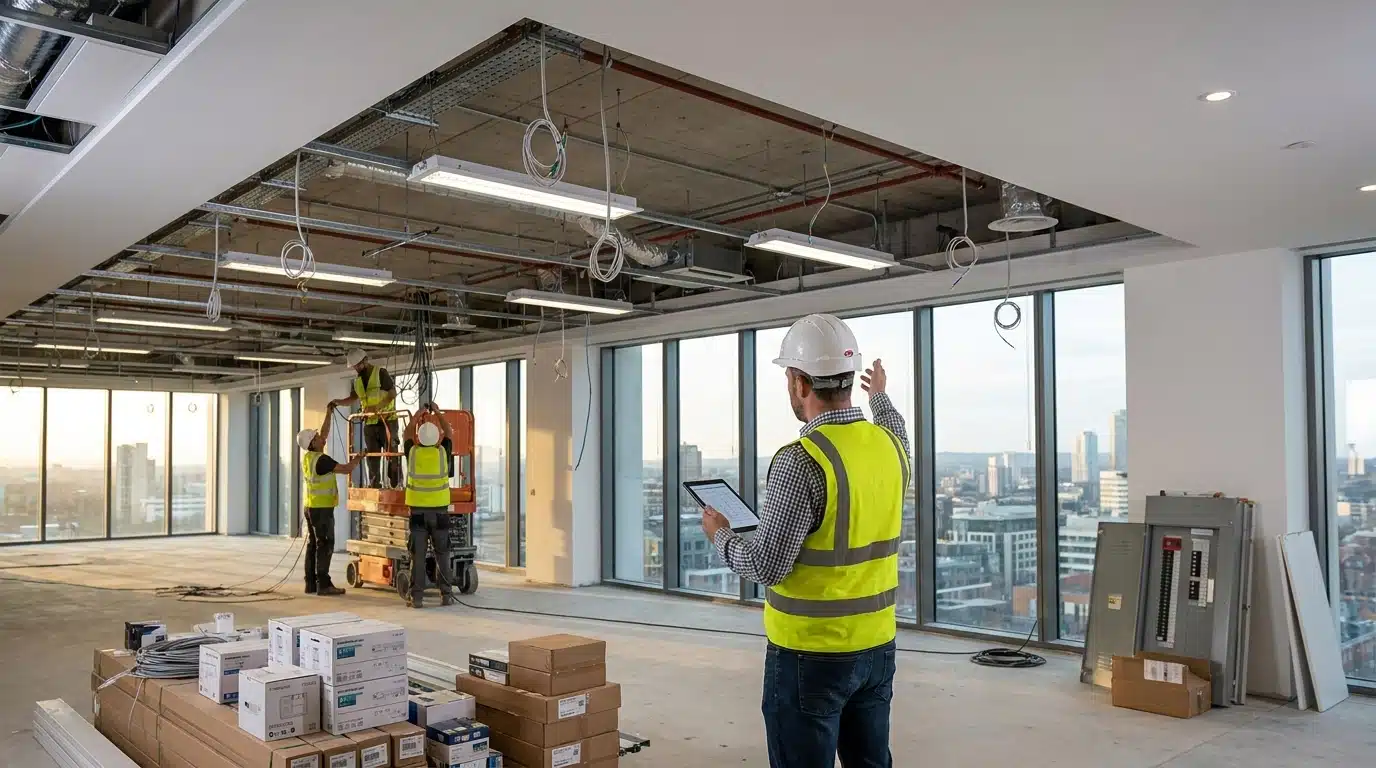
Lighting code issues often involve buried wiring or incorrect low-voltage control pathways that are hidden behind walls. If an inspector identifies a fundamental wiring error, the contractor must access those components directly. This often means tearing out brand-new drywall and removing expensive aesthetic finishes that were just completed. The structural damage required to fix a simple electrical error can be extensive and costly. For example, on a recent five-story medical office building project we audited in Tampa, correcting a minor low-voltage routing error after drywall installation required tearing out over 300 linear feet of finished wall and cost the developer an additional $15,000 in drywall patching and paint repairs alone.
Crews may also need to dismantle acoustic ceilings and integrated lighting fixtures to correct emergency egress circuits. These circuits must be wired to operate independently during a power failure to ensure safe evacuation.
Re-accessing these systems after the building has been finished creates a massive mess and delays other final touches. Developers must also pay for secondary trade costs to repair the damage caused by the electrical rework.
Supply Chain Lead Times and Equipment Delays
If an inspector rejects a commercial lighting system due to non-compliant fixtures, the contractor must order completely new equipment. Most commercial lighting components are custom-ordered to meet the specific needs of a large-scale development. Replacing these parts can take significant time, with lead times of 8 to 12 weeks for custom dimming panels.
Waiting for backordered components stalls progress, halts secondary trades, and leaves the project non-operational. These cascading delays maximize holding costs, increase interest accruals, and trigger expensive lease penalties for missed delivery dates.
Mitigating Risk with Private Providers and Commissioning
First-time compliance protects profit margins and keeps doors opening on schedule. This milestone requires partnering with a top-tier electrical subcontractor who understands the stakes and the technical requirements. Proactive planning and expertise are the best defenses against the compounding costs of an inspection failure in the competitive Florida market.
Utilizing Private Providers under Statute 553.791
Florida Statute 553.791 allows property owners to hire licensed Private Providers for building code inspections instead of waiting for local officials. The legislation requires local jurisdictions to accept these private reports, which can significantly fast-track the approval process. Contractors commonly use private providers to bypass municipal backlogs and keep a construction project on its original timeline.
Digital permitting platforms like Accela often experience municipal review backlogs, which can stretch re-inspection wait times into weeks. In contrast, hiring a licensed Private Provider allows developers to schedule and complete compliance inspections within days, bypassing local administrative delays entirely and keeping the construction schedule on track.
Mandatory Functional Testing and Section C408.3
The Florida Building Code, Energy Conservation Section C408.3, mandates that lighting control systems must be systematically tested before a final inspection. This process, known as commissioning, ensures that every component of the system is calibrated and working correctly. A professional contractor conducts FBC-mandated 20-minute timeout verification and photosensor calibration well before the municipal inspector arrives on the jobsite.
During a pre-commissioning check, a skilled electrical team verifies every occupancy sensor and daylight-harvesting zone. They test the emergency backup batteries and ensure that all automatic time-switches are programmed to the correct schedule. This commitment to testing saves the developer from the stress and expense of a stalled project. Because FBC Section C408.3 requires certified evidence of performance before a final inspection, Suncoast Power provides the technical commissioning services necessary to secure your Certificate of Occupancy and avoid costly penalties without delay.
Step-by-Step Commissioning Preparation
Passing the final FBC Section C408.3 inspection requires meticulous preparation before the municipal official arrives. A qualified electrical contractor will execute a documented sequence of performance tests to verify system compliance.
| Verification Phase | Targeted System | Testing Protocol & Compliance Goal |
| 1. Photosensor Calibration | Daylight-Responsive Controls | Map and calibrate photosensors to ensure artificial fixtures dim automatically and proportionally when natural light hits the designated foot-candle threshold. |
| 2. Vacancy Timeout Verification | Occupancy/Vacancy Sensors | Conduct a physical walkthrough of all controlled zones to confirm that dual-technology sensors reliably trigger the FBC-mandated 20-minute vacancy timeouts without false positives. |
| 3. Plug Load Audit | Automatic Receptacles | Test and verify that 50% of the electrical outlets in all private offices successfully cut power once the space remains unoccupied. |
Speak To Suncoast Power About Your Commercial Lighting Project
The financial risks of failing a commercial lighting inspection are too significant to ignore. Between the cost of delayed occupancy, high-interest carrying charges, and the physical expense of tearing out finishes for rework, a single failure can devastate a project budget. Investing in premier electrical expertise from the very beginning is the most effective way to protect your profit margins.
Suncoast Power has served as a trusted partner for developers and general contractors across Tampa for over 40 years. Our deep understanding of local codes and our commitment to professional pre-commissioning protect your project from the costly ripple effects of a failed inspection. We provide the reliable infrastructure and technical precision needed to keep your facility powered and your schedule intact. Contact us to learn more about our comprehensive electrical services and our proven track record.