


Effective retail storefront lighting turns a building facade into a high-performing sales asset for businesses across Tampa and the Florida Suncoast. Professional lighting design moves beyond basic visibility to create a visual environment that guides customers from the sidewalk to the sales floor.
Effective illumination drives in-store sales by shaping how shoppers perceive product quality. It provides the customer engagement metrics and increased visual dwell time necessary to maintain a competitive edge in modern commercial centers.
Influence of Strategic Retail Storefront Lighting on Consumer Behavior
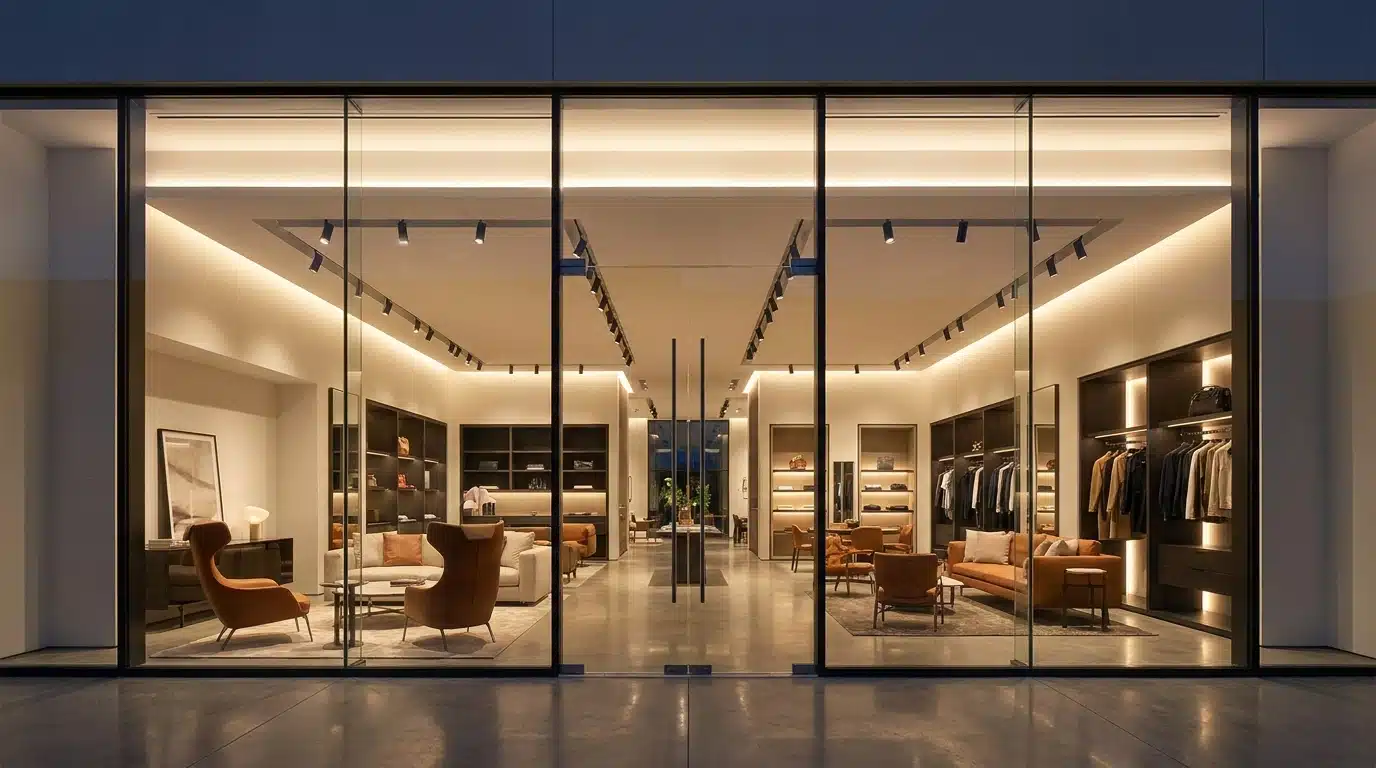
Phototaxis describes the natural human inclination to move toward well-lit spaces and away from shadows. In a retail environment, this biological response shapes how prospective shoppers interact with a storefront. Lighting serves as a silent form of visual communication that shapes first impressions and encourages pedestrians to transition into active showroom visitors.
Capturing Shopper Attention Through Window Displays
Window displays are the first point of contact between a brand and potential customers. To capture retail foot traffic, these displays must overcome the challenges of exterior glass reflections and competing daylight glare. High-intensity directional spots make specific items pop against the background, keeping the display visible even in bright afternoon sun.
Visual merchandising relies on these light sources to craft a compelling narrative that elevates premium products. By creating curated focal points, retailers can guide the viewer’s eye toward specific promotions or high-margin items. As the sun sets, the transition to evening storefront presentation requires a high-contrast lighting layout with specific luminance ratios to maintain the same allure without overwhelming the sidewalk.
Guiding Navigation and Increasing In-Store Dwell Time
Once a customer enters the building, light gradients subconsciously guide them through a defined store journey. Subtle shifts in brightness help shoppers understand the layout without excessive signage. Proper showroom lighting design reinforces brand identity at every turn while preventing shoppers from wandering off track.
Well-balanced light levels eliminate dark corners that can make a space feel neglected or unsafe. A clean, well-lit environment instills a feeling of luxury that naturally increases customer dwell time. When shoppers feel comfortable enough to linger, they are far more likely to increase their basket size and finalize a purchase.
Primary Lighting Layers for Effective Showroom Lighting Design and Retail Storefronts
Successful showroom lighting design cannot rely on a single, uniform light source to cover the entire sales floor. Professionals use the architectural concept of lighting layering to create a balanced environment. This approach involves the deliberate interplay of specific fixture types to meet diverse functional needs:
- Ambient Lighting: Provides general, baseline illumination for safe navigation.
- Accent Lighting: Highlights specific merchandise and architectural features.
- Task Lighting: Supports high-detail activities at checkout counters and fitting rooms.
Ambient Illumination: Establishing Baseline Comfort and Brand Identity
Ambient lighting serves as the foundational canvas for any retail storefront lighting strategy. It provides the general illumination customers need to move safely and comfortably throughout the store. Designers typically aim for 20 to 50 foot-candles in general circulation areas, providing enough light for safety while leaving room for dramatic accents.
Over-illuminating the ambient space is a common mistake that can strip displays of their visual depth. When the background light is too intense, textures appear flat, and products lose their three-dimensional appeal. Following Illuminating Engineering Society standards for general retail circulation ensures the space remains inviting without competing with focal displays.
Accent Illumination and Focal Lighting: Elevating Featured Products
Accent illumination creates focal points that separate high-margin merchandise from the general background. By utilizing adjustable directional spots and recessed gimbals, retailers can highlight new collections or seasonal endcaps with precision. Focal highlighting makes products appear more desirable by emphasizing the surface characteristics of materials like brushed metal, woven textiles, or polished stone.
Visual merchandising teams frequently employ wall washers and narrow-beam optics to sculpt depth within a display. These fixtures allow visual merchandising teams to create a clear hierarchy of importance across the showroom floor. When targeted focal lighting is applied correctly, it commands immediate attention and draws the shopper’s hand toward the product. Professionals often use 150 foot-candle accents to ensure these focal points stand out against the ambient baseline.
Task and Perimeter Lighting: Supporting Checkout and Interaction
Task lighting focuses on specific areas where employees and customers must interact or complete transactions. At point-of-sale terminals and service counters, bright and clear illumination is necessary for processing payments and reviewing paperwork. Adequate vertical, flattering light at face level ensures staff and customers can communicate effectively without straining their eyes.
Perimeter lighting techniques like vertical wall grazing help visually expand a showroom’s footprint. By illuminating the boundaries of the space, retailers pull customer sightlines toward the edges of the room, making the store feel larger. Wall grazing also ensures wall-mounted merchandise gets the same attention as floor displays.
Fitting rooms require special attention to task lighting because they directly impact apparel purchasing decisions. Shadows or off-color light in these spaces can lead to buyer dissatisfaction and abandoned sales. Experts recommend 300 to 500 lux of vertical illuminance with warm-neutral temperatures to create a flattering reflection.
Mastering Contrast Ratios for Effective Retail Storefronts
Contrast is the primary tool lighting designers use to create drama and visual hierarchy within a commercial space. The human eye responds not to absolute brightness but to the differences in luminance between an object and its surroundings. By manipulating these ratios, a designer can dictate exactly where a customer looks first.
Establishing the Proper Ratios: Balancing General Illumination and Display Drama
Standard industry guidelines suggest specific contrast ratios to achieve different merchandising goals. For subtle product definition in a general sales area, a 3:1 ratio between the product and the background is often sufficient. When a retailer wants to create a prominent feature display, a 5:1 ratio is typically recommended to ensure the merchandise stands out clearly.
High-impact window displays and luxury showroom vignettes often require much higher ratios to capture attention from a distance. Ratios between 15:1 and 30:1 are frequently used to create a theatrical effect that stops pedestrians.
Merchandise Display Illumination and Visual Journey Control
Directional spots and narrow-beam optics are essential for eliminating visual noise that can distract from the main merchandise display illumination. By tightly controlling where the light falls, designers can guide the customer’s eye through the showroom without unnecessary peripheral distractions. Choosing the correct beam angle is the difference between a precise highlight and a broad, washed-out display.
Visual merchandising teams often use narrow spot beams to highlight inventory precisely on jewelry or small luxury items. For broader product groupings, wide floods provide a consistent wash that covers the entire shelf or table. This focus ensures only the intended merchandise captures the shopper’s attention while maintaining the brand aesthetic.
Why High CRI Retail Lighting Is Critical for Accurate Color Fidelity
Color fidelity matters. In modern retail spaces, the Color Rendering Index (CRI) serves as a non-negotiable baseline. Failing to represent product hues accurately leads directly to distorted perceptions and buyer dissatisfaction. High-CRI retail lighting ensures the vibrancy and hue of merchandise are showcased exactly as intended by the manufacturer.
Investing in quality lighting directly impacts retail profitability and operational efficiency. High CRI lighting improves color accuracy in retail displays, which helps customers feel more confident in their selections. It also enhances the brand’s perceived value by creating a crisp, professional environment where colors look saturated and true to life.
Deconstructing the Color Rendering Index and R9 Values for Retail Accuracy
CRI is measured on a scale from 0 to 100, with higher numbers indicating better color accuracy. While standard commercial lighting often uses a CRI of 80, luxury retail and fashion environments require at least a CRI of 90. For jewelry and high-end cosmetics, many professionals specify CRI 95 or higher to capture the finest details and color nuances.
The R9 value is an equally important metric that measures the rendering of saturated deep red tones. These red values are critical for accurately displaying wood grains, leather goods, textiles, and human skin tones. Professionals recommend an R9 value of at least 50 for fashion and luxury retail, while jewelry and high-end cosmetics showrooms require a minimum R9 value of 70.
Correlated Color Temperature and Showroom Ambiance
While color accuracy dictates how true a product looks, Correlated Color Temperature (CCT) establishes the emotional tone of the entire space. Measured in Kelvin, CCT determines whether the light feels warm and inviting or cool and energizing.
Luxury boutiques often select warmer temperatures around 2700K to 3000K to create an intimate, relaxed atmosphere. Conversely, modern apparel or technology showrooms lean toward cooler 3500K to 4000K temperatures to project a crisp, high-energy environment that emphasizes stark contrasts.
The Business Impact of Color Fidelity on Return Rates
One of the biggest issues in retail is metamerism, where a product appears one color in the store but looks different under natural sunlight. Such color shifting is a leading cause of post-purchase merchandise returns in the fashion and home decor industries. When a showroom uses high-CRI lighting, buyer confidence increases because product color stays consistent across different environments.
Accuracy speeds decision-making and reduces the time staff spends processing returns. A truthful representation of color also enhances the brand’s perceived value. Shoppers view a retailer as professional and high-end when the environment feels crisp, and colors look vivid.
Implementing the five-foot-seven-inch lighting rule to Optimize Customer Line of Sight
The five-foot-seven-inch lighting rule is a retail merchandising principle in which primary light sources and product displays are centered at average eye level, about 67 inches above the floor. This datum line is known as the buy level because it maximizes product visibility and customer engagement.
Vertical illumination and focal track head aiming should always center on this critical visual line. When light sources are positioned too high, they can cast unflattering downward shadows that obscure a product’s features. If fixtures are aimed too low, they may cause direct glare that blinds the shopper and forces them to look away from the display.
Proper sconce positioning and display lighting should follow this rule to maintain a consistent visual experience across the sales floor. When a customer walks through a showroom, their eyes should naturally land on highlighted items without having to look up or down excessively.
Technical Execution and Showroom Infrastructure
Integrating Smart Lighting Controls and Automation
Modern retail facilities require more than simple manual switches to support operational goals. Smart building controls serve as the technical link between design aesthetics and electrical efficiency. These systems provide precision and automation that simplify facility management while reducing energy costs.
Smart lighting systems utilize Digital Addressable Lighting Interface (DALI) or 0-10V dimming protocols to adjust light levels based on the time of day. This compatibility allows for automated scene setting, where lighting levels can shift for special events or evening presentations. These controls ensure retail storefront lighting stays optimized for current foot traffic and ambient light conditions.
Maintenance Strategies for Sustaining Showroom Lighting Quality
Maintenance strategies for sustaining showroom lighting quality prevent the slow degradation of visual appeal over time. Scheduled electrical inspections and fixture cleanings ensure that dust accumulation doesn’t reduce total lumen output. Replacing lamps before they reach the end of their rated life helps avoid inconsistent color temperatures across the sales floor.
Lumen depreciation can silently erode the effectiveness of a high-contrast layout if not monitored properly. Facility managers should implement a re-aiming schedule to ensure track heads haven’t shifted during seasonal merchandise rotations. Consistent upkeep protects the long-term value of the electrical assets and supports a positive customer experience.
Fixture Selection: Track Lighting and Directional Spots
Retail floor layouts and seasonal promotions change frequently, so the lighting system must be highly adaptable. Fixed lighting positions often become obsolete as new merchandise arrives or endcaps are repositioned. Versatile hardware lets store managers maintain high-quality illumination as the showroom evolves.
Commercial track lighting systems are standard for boutique and showroom environments because of their flexibility. Multi-circuit systems, such as three-circuit tracks, allow for independent switching and dimming control over different fixtures on the same rail. This means a manager can adjust the ambient wash and the accent spots separately without changing the wiring.
Visual merchandising teams can easily reposition, swap, or re-aim track heads whenever floor configurations rotate. For general merchandise, a 24 to 36 degree beam angle on an adjustable LED head provides a versatile balance of coverage and focus. This ability to update the lighting layout without expensive contractor visits makes track systems a cost-effective choice for dynamic retailers.
Florida Electrical Codes and Energy Requirements for Commercial Retail Lighting
An aesthetic lighting vision must always be grounded in the realities of electrical engineering and building codes. Failing to plan for these requirements can lead to costly project delays, fire hazards, and significant code violations. Professional electrical planning ensures that the lighting system is not only beautiful but also safe and compliant.
Commercial retail facilities are subject to strict energy conservation standards, including American Society of Heating, Refrigerating and Air-Conditioning Engineers (ASHRAE) 90.1. These regulations define the maximum Lighting Power Density (LPD) allowed in a space, typically measured in watts per square foot. In the 2020 Florida energy code, the sales area is generally restricted to 1.22 watts per square foot.
The Florida Building Code regulates lighting power density to ensure efficiency across all commercial developments. For many retail spaces, the allowance is calculated as 500 watts plus the area of specific retail zones multiplied by 0.6 or 1.4 watts per square foot, depending on the category. Suncoast Power installs commercial electrical infrastructure in Florida and provides these certified electrical load calculations to ensure full compliance.
Power Distribution, Circuit Loading, and Safe Infrastructure
A commercial electrical contractor manages the complex power distribution a showroom needs. Retail environments often require dedicated branch circuits to handle the continuous loads of lighting systems that run for 12 or more hours a day. National Electrical Code guidelines dictate how to size these circuits to prevent breaker trips during peak hours.
Proper infrastructure also includes managing heat dissipation within dropped ceiling plenums and ensuring all conduit runs are installed correctly. Commercial contractors must balance phase loads to prevent circuit overloads and ensure the longevity of the electrical panels. A well-designed system can scale as the retail floor layout evolves over the years.
Safety is the top priority when installing high-density lighting in a public space. Using a licensed commercial electrical contractor ensures that every fixture is grounded and every connection is secure. This professional oversight protects the business from electrical fires and keeps the facility operational without unexpected downtime.
Speak To Suncoast Power About A Commercial Lighting Upgrade
Strategic lighting is much more than a functional requirement. It’s an engineering and business investment that drives tangible return on investment. By combining ambient foundations with high CRI accents and mastered contrast ratios, you create an environment that naturally attracts foot traffic and reduces return rates. Following sightline rules and maintaining a robust electrical infrastructure keeps your showroom safe and drives sales effectively.
Suncoast Power understands that a successful retail environment depends on seamlessly integrating design and technical engineering. From new retail construction and shopping centers to complex showroom retrofits, we ensure your infrastructure is high-quality, safe, and future-ready.
Contact us today to schedule a comprehensive electrical consultation for your Central Florida business and discover how we can drive your retail growth. Our team is ready to deliver the scalable, efficient lighting solutions your property deserves.