


Lightning struck your building or a neighbor's roof, and now your expensive equipment is fried. You have to decide whether to put lightning rods on the roof or invest in surge protection and grounding, and guessing wrong leaves your facility exposed to the next storm.
Rods on the roof protect the structure from fire and structural damage but don't stop surges on your wiring, so surge protection and grounding at your panels matter whether or not you add rods. Whether the rods are worth adding depends on your building's physical risk factors.
What rods on the roof protect against
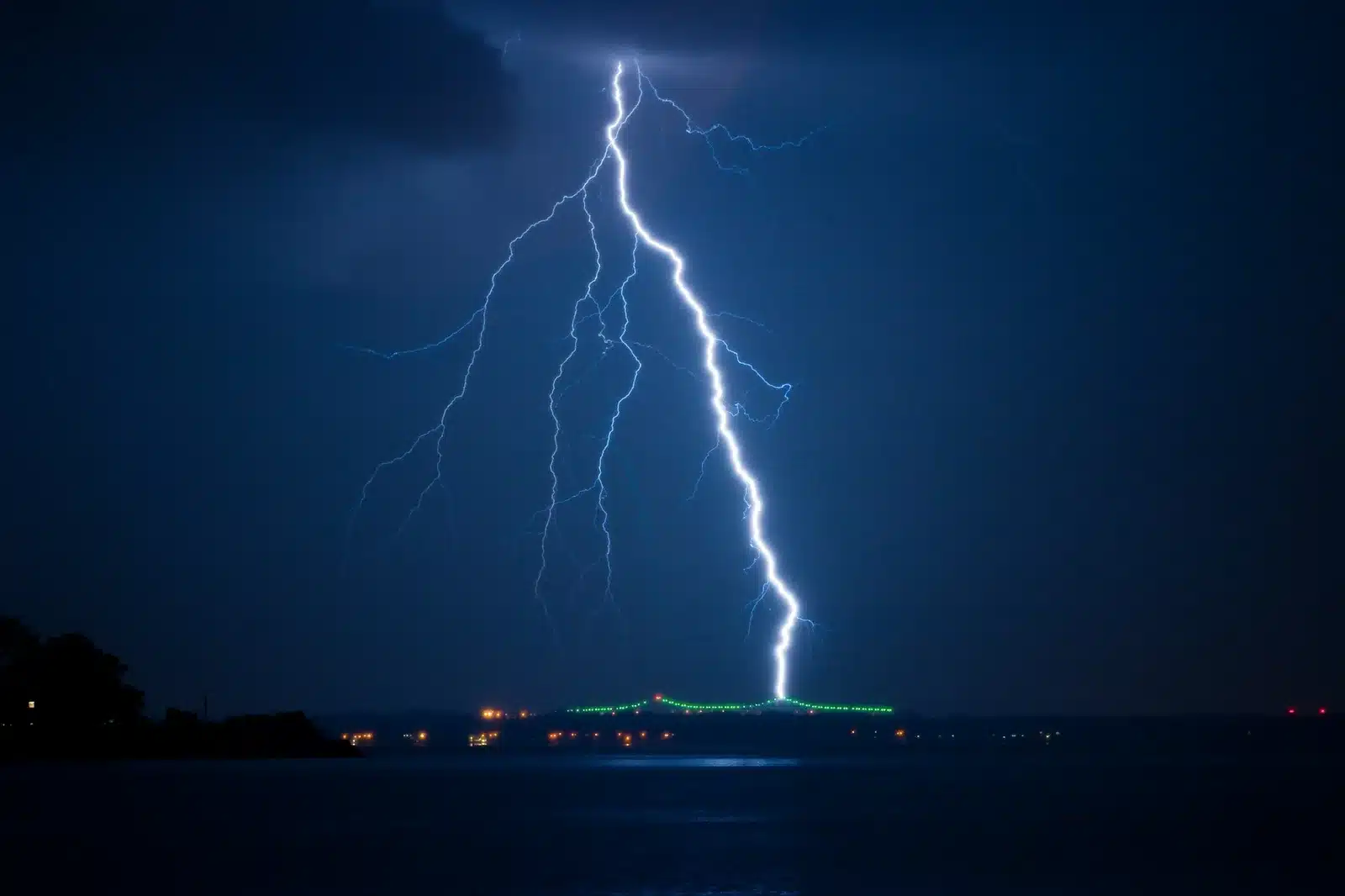
A rooftop lightning protection system built to National Fire Protection Association (NFPA) standard NFPA 780 protects your physical building and its occupants from fire and structural damage, but the rods alone do not stop surges in your internal wiring. As the National Institute of Standards and Technology (NIST) explains, grounded lightning rods protect the structure and prevent fires, but they don’t prevent surges in the wiring
that ruin appliances and electronics.
The exterior hardware gives a direct strike a controlled path into the earth. It uses three parts: air terminals (the metal rods mounted on the roof), conductors (heavy cables that carry the current down the building), and grounding electrodes (buried rods or plates that dissipate the charge into the earth).
Keeping lightning on that outside path is what prevents the fire, a hazard that also shows up in aging commercial electrical systems. Between 2004 and 2008, U.S. fire departments responded to an average of 24,600 lightning-started fires per year, causing $407 million in annual direct property damage according to NFPA research on lightning fires.
What surge protection devices stop
A surge protective device (SPD) wired into your electrical system clamps down on sudden voltage spikes before they reach your equipment. Under NFPA 780-2023, an SPD is a protective device for limiting transient voltages by diverting or limiting the surge current
while staying ready to repeat that job after the spike passes. For commercial alternating current (AC) panels, the NEMA Surge Protection Institute notes that every unit should be listed or recognized to the UL 1449 safety standard so the device itself does not become a fire or personal safety hazard.
Where an SPD sits on your wiring determines which spikes it catches, and UL 1449 Edition 5 divides commercial units into three categories by installation location:
-
Type 1 devices connect permanently ahead of the main service disconnect (and can also sit on the load side).
-
Type 2 devices connect permanently on the load side of the main service disconnect, including at branch panels.
-
Type 3 devices sit at the point of use, installed at least 10 meters from the service panel, such as receptacles or plug-in units.
You might assume a strike has to hit your roof to ruin your servers or HVAC controls. It doesn’t. Lightning also causes indirect surges by inducing voltage into electrical circuits, and those spikes travel into your building along power, telephone, and cable lines when a bolt hits a neighbor’s roof or a utility line. Because that voltage arrives on the incoming wires, rods on your roof won’t stop it.
Which damage each component prevents
Rooftop components governed by NFPA 780 and UL 96A keep lightning current on the outside of the building to prevent structural damage and fire, while SPDs governed by UL 1449 stop voltage spikes on the wiring to prevent equipment loss. As the UL Solutions Lightning Protection Application Guide explains, a complete system combines strike termination devices, conductors, grounding electrodes, interconnecting conductors, and SPDs so that neither path is left open.
The side-by-side table
|
Component |
What it does |
Governing standard |
Damage it prevents |
|---|---|---|---|
|
Air terminals (strike termination devices) |
Intercept the lightning strike at the roof |
NFPA 780, UL 96A, UL 96 |
Structural damage and fire from direct rooftop strikes |
|
Main and down conductors |
Carry lightning current from the air terminals down to the ground |
NFPA 780, UL 96A, UL 96 |
Fire and structural damage along the building exterior |
|
Grounding electrodes |
Dissipate the lightning current safely into the earth |
NFPA 780, UL 96A, NFPA 70 |
Structural damage and fire at the base of the system |
|
Interconnecting bonding conductors |
Connect the lightning grounding and incoming services to the building’s electrical ground |
NFPA 780, UL 96A, NFPA 70 |
Dangerous voltage differences between grounded systems |
|
Type 1 SPD |
Diverts incoming surges on the line or load side of the main service entrance |
UL 1449, NFPA 780 |
Equipment and electronics loss from external utility and service line surges |
|
Type 2 SPD |
Limits transient voltage on the load side of the main disconnect and at branch panels |
UL 1449 |
Equipment and electronics loss on internal branch circuits |
|
Type 3 SPD |
Clamps residual voltage spikes at least 10 meters from the panel right at the equipment |
UL 1449 |
Sensitive electronics and appliance loss at the point of use |
|
Signal, data, and communications surge protectors |
Limit surges where data or communication cables enter or exit the building (or run over 100 feet) |
NFPA 780 |
Loss of low-voltage, network, and communications equipment |
If your building took no roof or wall damage during the storm, but your circuit boards, compressors, or network switches failed, your loss sits in the bottom half of this table. The spike traveled along your power or data lines, which only SPDs and proper grounding can address.
Bonding the two grounding systems
When a building has rooftop rods, tying their ground into your electrical ground keeps both systems at the same voltage during a strike. That connection is called bonding, and it links the lightning ground to your grounding electrode system, which is the network of buried rods, pipes, or plates that grounds your normal electrical service.
Under NFPA 70 (National Electrical Code) Section 250.106, the lightning protection system ground terminals shall be bonded to the building or structure grounding electrode system.
The NFPA 780 report adds in Annex A.4.13.1 that you should make this connection as near the service entry as reasonable and run it directly without meandering through the building.
What the NFPA 780 risk assessment weighs
Whether rods are worth adding depends on the calculation in NFPA 780 Annex L, which compares the expected annual threat of a strike hitting your building with a tolerable lightning frequency based on what is inside. If the expected threat exceeds the tolerable frequency, the standard recommends a full system.
How often lightning strikes ground in Tampa Bay
The assessment begins with flash density, the number of cloud-to-ground lightning strikes per square kilometer per year in your location. For Florida, the Vaisala Xweather 2025 lightning report recorded roughly 305 lightning events per square mile in 2025, the highest density of any U.S. state. That’s a statewide count in different units, but it tells you the baseline strike threat in an NFPA 780 assessment here starts high before you even measure the building.
What the building itself adds to the risk
Your building’s height, surroundings, and contents determine whether that high local strike rate translates into a recommendation for rooftop rods, using six factors in the Annex L formula:
-
The equivalent collection area, which expands with the building’s height and footprint.
-
An environmental coefficient that accounts for surrounding trees or taller buildings.
-
The construction materials used in the structure and roof.
-
How valuable or vulnerable the contents inside are.
-
Occupancy numbers and how difficult an evacuation would be.
-
Consequences to ongoing operations or the surrounding community if a strike hits.
When you run your property through those factors, a low, wide building surrounded by taller structures whose only storm damage was fried electronics has a very different risk profile from an isolated tower. If your operations depend on sensitive electrical equipment, the wiring is where you’re most exposed.
When the code or an insurer asks for rods
Sometimes a code official or insurance carrier makes the decision for you. In Florida, a Florida Building Code staff comment on Section 2703.1 explains that new buildings and additions must have an NFPA 780 system, unless the property is a one- or two-family dwelling or an NFPA 780 risk assessment (or another method approved by the authority having jurisdiction) shows the system is unnecessary.
On the insurance side, FM Global Property Loss Prevention Data Sheet 5-11 recommends installing lightning rods on buildings that contain or process ignitable liquids or flammable gases of significant value or importance, especially in high-risk lightning areas, following NFPA 780 installation rules.
Protecting the electrical system with or without rods
NFPA 780 Section 4.20 requires SPDs at all power service entrances and at the entry or exit points for signal, data, and communications lines (as well as external lines running over 100 feet). Because the standard treats that protection as part of a full system, you need the surge protection and grounding work at your panels whether or not you put rods on the roof.
A roof inspection won’t show whether your electrical system can safely divert a surge into the earth. A commercial electrician tests that at the panels and the ground:
-
Ground resistance testing using the IEEE Std 81 fall-of-potential method (cited in ITU-T Recommendation K.107), which passes a current between the earth electrode and a current probe while measuring voltage at set distances.
-
Compliance with NEC Section 250.53(A)(2), which requires supplementing a single rod, pipe, or plate electrode with a second electrode unless the single electrode measures a resistance to earth of 25 ohms or less.
-
UL 1449-listed SPDs installed at the service entrance and branch panels.
-
A direct bond connecting any lightning protection ground terminals to the building’s grounding electrode system.
At Suncoast Power, we perform commercial electrical risk assessments across Tampa Bay and Central Florida to identify electrical hazards, weigh the likelihood and severity of harm or damage, and put controls in place to reduce those risks. When we handle your preventative electrical maintenance, we run regular inspections, test current, check for improper grounding, and repair or replace damaged wiring.
Who designs and certifies a rooftop system
If your risk assessment or insurer calls for rooftop air terminals, the finished installation is certified through UL Solutions, while your commercial electrician handles the panel SPDs and the ground bond at the service entrance. Under the UL Solutions Master Label Certificate program, an inspector verifies that the complete structure’s installation complies with UL 96A and NFPA 780, and the certificate it issues stays valid for five years before reinspection.
The people who design and build that exterior system come through the Lightning Protection Institute (LPI) certification program, which tests contractors for Journeyman Installer (JI), Master Installer (MI), and Master Installer/Designer (MID) credentials.
Speak to an expert at Suncoast Power about your building’s surge protection
A storm in Tampa Bay or Central Florida can put voltage on your utility and data lines even when the bolt hits down the street. Whether you need rods depends on your NFPA 780 risk score and what your code or insurer asks, but you need surge protection and a verified ground either way. NFPA 780 requires SPDs at all power service entrances and on data lines entering the building or running over 100 feet. A single grounding rod needs a supplemental electrode unless it tests at 25 ohms or less.
If storm surges damaged your equipment and you’re weighing rooftop rods against panel upgrades, have a commercial electrician check your surge protection and grounding before you decide. Schedule a free site audit with Suncoast Power or call us at (813) 822-4107, and we’ll inspect your grounding, test your panels, and show you what your electrical system needs to stop the next surge.