Emergency Responder Communications Enhancement Systems

Code-Compliant Radio Coverage for Fire, Police, and EMS Inside Your Building

When firefighters, police officers, and paramedics enter a building, their portable radios have to work in every stairwell, elevator lobby, parking level, and mechanical room. Concrete, steel, low-E glass, and below-grade construction routinely block the public safety radio signal that reaches the front door. An Emergency Responder Communications Enhancement System (ERCES) corrects that problem, and it is now a fire code requirement for new construction and for many existing buildings. Suncoast Power designs, installs, tests, and maintains ERCES for commercial, industrial, multifamily, healthcare, and hospitality properties across Tampa Bay and Florida, and as a licensed electrical contractor we handle the dedicated power circuit and the fire department coordination that come with it.

"*" indicates required fields

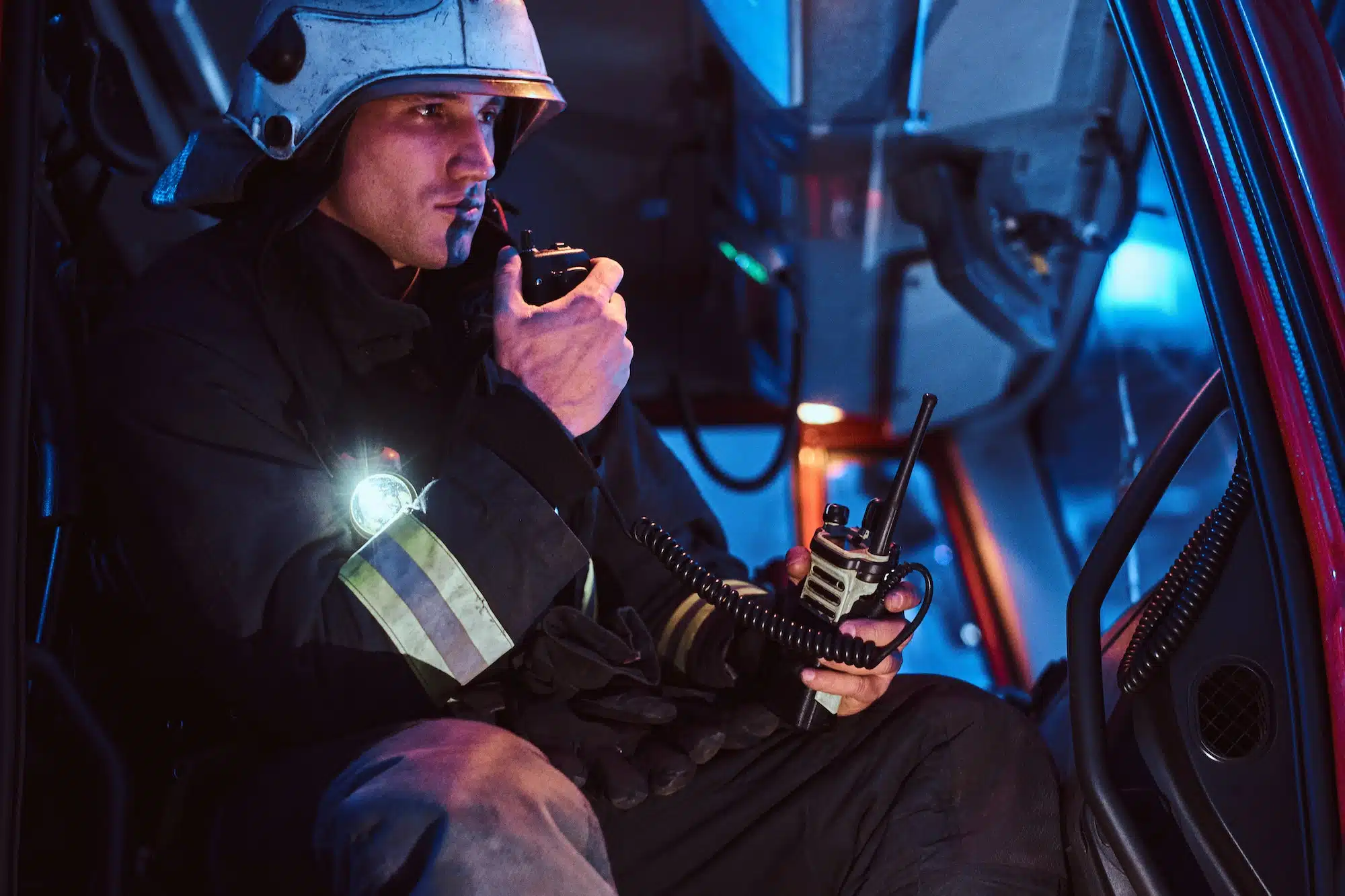
The fire brigade arrived at the night-time
What Is an ERCES?

Dedicated In-Building Coverage for Public Safety Radio

An ERCES is a two-way radio system that extends the local public safety radio network into parts of a building the outdoor signal cannot reach on its own. Fire, police, and EMS radios operate on licensed frequencies in the VHF, UHF, 700 MHz, and 800 MHz bands, and in most jurisdictions they talk to a regional trunked network such as a P25 system. A firefighter standing in a parking garage or a concrete stairwell may be well below the signal level needed to reach the nearest tower. The ERCES receives the signal at a rooftop donor antenna, amplifies it through a bi-directional amplifier (BDA), and distributes it through a network of indoor antennas. Transmissions from the portable radio travel the same path in reverse, out to the donor site.

contractors revewing plans

Get Our Free ERCES Compliance Guide

A nine-page guide for general contractors, developers and building owners, written against Florida Statute 633.202 and the Florida Fire Prevention Code 8th Edition rather than the International Fire Code that most published material describes. Our guide includes:

  • Which statute and code edition actually apply in Florida
  • The four building categories that are exempt outright
  • The exterior signal test that can end the question early
  • Coverage, signal, battery, enclosure and listing thresholds
  • Six reasons systems fail acceptance testing
  • What Florida law protects owners and GCs from
  • Phase-by-phase sequencing, and who should hold the scope
  • An eighteen-point preconstruction checklist

Buildings That Typically Need an ERCES

Any building can fail a signal survey, but certain types fail far more often than not. If your property fits one of these descriptions, schedule the survey early in the project

facade of multistorey building for rent, copy space.

High-rise office and residential towers

Reflective glass, steel framing, and distance from the donor site weaken the signal on upper floors, while stairwells and elevator shafts in the concrete core block it almost entirely.

Indoor parking lot

Parking garages and below-grade levels

Concrete and earth stop radio signals. A garage under an otherwise compliant building is usually the first place a survey fails, and it is a critical area for responders.

Hospital urgencies hallway indoor reception desk. Health center interior. Medicine

Hospitals and medical office buildings

Lead-lined imaging rooms, dense mechanical infrastructure, and large footprints create dead zones. Healthcare occupancies also have clinical equipment, shielded rooms, and infection control constraints that have to be accounted for in both the design and the installation schedule.

blurred defocused background of roulette at casino saloon gambling concept with unfocused game room with video poker slot machines and multicolored blurry lights

Hotels, resorts, and casinos

Large floor plates, back-of-house corridors, and guest room wings far from exterior walls. Resort properties on the coast also face NEMA 4X and corrosion requirements for rooftop equipment.

empty baseball stadium

Stadiums, arenas, and convention centers

Thick structural concrete, below-grade service levels, and crowds that make reliable radio contact a public safety priority on event days.

how to evaluate electrical contractor bids for commercial developments

Schools, colleges, and government buildings

Some districts and agencies write ERCES into their design standards for new campus construction, and existing buildings are commonly assessed during renovations.

Firefighter Holding Walkie-talkie While Standing By Coworkers
When Does Code Require an ERCES?

The Codes and Standards That Apply

Code requires an ERCES when the public safety radio signal inside the building falls below the minimum level set by the fire code and the local authority having jurisdiction (AHJ). The requirement is performance-based: the building must meet signal strength and audio-quality thresholds, and if it doesn’t, the owner must install a system to meet them. Two things come before that test in Florida: a list of statutory exemptions, and an exterior signal check that can end the conversation before it starts.

  • Florida Statute 633.202(18)
  • Florida Fire Prevention Code, 8th Edition (2023)
  • NFPA 1221 (2019)
  • NFPA 1225 (2022), Chapter 18
  • NFPA 72
  • ANSI/CAN/UL 2524 (3rd edition, 2024)
  • FCC Part 90
  • International Fire Code, Section 510

How an ERCES Differs From a Cellular DAS

An ERCES is a life safety system, in the same category as a fire alarm or a sprinkler system. It operates on frequencies licensed to a public safety agency rather than to a wireless carrier. Active equipment must carry a UL 2524 listing, run from a dedicated circuit with battery backup, sit inside NEMA 4 enclosures, and report trouble conditions to the building fire alarm panel. The finished installation has to pass an acceptance test witnessed by the fire marshal, and it has to be retested every year. A cellular DAS improves phone and data service for tenants and guests. An ERCES keeps responders talking during a fire, a medical call, or a security incident. Many buildings need both. The two systems are designed and permitted separately, and whether they can share any passive infrastructure is a decision that belongs to the local fire code official.

network technician inspecting servers in data center red neon light
How an ERCES Works

Signal Path and System Components

A rooftop donor antenna picks up the public safety radio signal and sends it to a bi-directional amplifier, which boosts it in both directions and distributes it through cabling to antennas on every floor, with dedicated coverage in stairwells, elevator lobbies, and other critical areas. Battery backup keeps the system running through a power outage, and an annunciator at the fire alarm panel reports any fault the way a sprinkler tamper switch would. Every active component is UL 2524 listed, and the whole system is tested by the fire marshal before it is approved and again every year after.

employees brainstorming ways to use ai
Our ERCES Services

Survey, Design, Installation, and Annual Testing From One Contractor

We survey your building to find out whether it needs a system, and if it does, we design it, pull the fire department permit, install it, and walk the inspector through the acceptance test. As a licensed electrical contractor, we also run the dedicated power circuit, so there is no second trade to coordinate. After acceptance, we come back every year to retest the system and issue the certification report the fire marshal expects to see.

Why Choose Suncoast Power for ERCES

A Licensed Electrical Contractor With Four Decades in Florida

An ERCES touches several trades at once: radio, structured cabling, electrical power, and fire alarm. Suncoast Power has been a licensed commercial electrical contractor in Tampa since 1982, and our cabling, low-voltage, backup power, and systems integration work already puts us in the risers, equipment rooms, and fire alarm panels an ERCES depends on.

home hero temporary c

Florida law requires the ERCES design to be submitted by an appropriately licensed contractor, and we bring that license, along with the RF survey and design work, to every project. Here’s how we run the project:

  • Benchmark survey before design. We measure before we draw. Designs built on measured signal data draw fewer plan review comments and fewer surprises at the witnessed test.
  • Design and permit submittal. Donor antenna location, coax routing, head-end space, power, battery backup, and antenna layout, drawn against the electrical and fire alarm plans. Submitted to the AHJ for review before we order equipment.
  • Rough-in with the building.Sleeves, pathways and cable go in with everything else, because our electricians are already on site. Two-hour rated cable where required, NEMA-rated enclosure, supervised 12-hour battery backup, and annunciation programmed into the fire alarm panel we are also installing.
  • Pretest and commissioning.We run the grid test ourselves and correct anything short before calling for inspection. Nobody benefits from a failed inspection on the record.
  • Acceptance with the AHJ.We walk the building with the fire marshal and stand behind the result. If something needs adjustment, our people are on site to make it.
  • Annual testing.These systems require annual inspection and testing after occupancy, and Florida caps how often a jurisdiction can force a full reassessment. We do it with the crew that installed the system and provide documentation for your records and your insurer.

Florida ERCES Requirements

Florida sets the in-building radio coverage requirement at the state level. Under Florida Statute 633.202(18), the local AHJ sets the minimum signal strength for fire department communications in all new and existing buildings, and two-way radio communication enhancement systems are the accepted way to comply.

The statute also contains several provisions that work in the owner’s favor, and they are worth knowing before a plan reviewer tells you otherwise:

  • The exterior signal test. Where the AHJ determines that public safety signal strength or audio quality is inadequate at the exterior of the building, neither a system nor an assessment is required. FFPC 11.10.2.1 sets the benchmark at a delivered audio quality of 3.4: if the signal arriving at the site does not meet it, the building cannot be asked to amplify it. This gate is routinely missed, and it is the fastest way to find out that a project has no obligation.
  • Exemptions. One- and two-family dwellings and townhouses; buildings under 12,000 gross square feet with no underground areas; apartments and transient lodging under three stories where units open directly to an exterior means of egress; and wood-frame apartment buildings 75 feet or less in height with fewer than 150 units and exterior-discharging corridors (the owner has to show wood-frame construction on the building permit).
  • Existing high-rises. Non-compliant existing high-rises had to apply for a permit by January 1, 2024, and be compliant by January 1, 2025. Both dates have passed. If you own or manage a Florida high-rise that has not addressed this, the first step is an assessment, which may find that no system is required.
  • Reassessment is capped. The AHJ may require a coverage assessment no more than once every 3 years for existing high-rises and existing buildings over 12,000 square feet, and once every 5 years for all other existing buildings, unless the building undergoes a Level III alteration or reconstruction, a public safety agency reports that its radios failed inside, or the building is found to be an imminent threat to responders.
  • A TCO cannot be withheld for this alone. Under s. 553.79, the AHJ may not withhold a temporary certificate of occupancy for a new building solely because an ERCES is needed. Once the design is approved, installation must be completed within 12 months of the TCO. The system does not have to be operational to open the building.
  • Local AHJs cannot be more stringent. A local authority may not enforce requirements more stringent than the FFPC on whether a system is required, how it is designed, or how it is installed. It does set the signal thresholds and the critical area list for its own radio system.
  • Notice before changes. If the jurisdiction modifies its radio system so that existing installations need changes, owners get at least 180 days’ notice, and at least 1 year from a notice of violation to complete a retrofit.
  • A licensed contractor submits the design. Where an assessment finds a system is required, a contractor holding the appropriate Florida license must submit the design to the AHJ.
  • License holder consent. Any new system or modification requires the written consent of the agency that holds the radio license, kept on file in a form that can be produced for the FCC.

The Florida Fire Prevention Code, 8th Edition, adopts NFPA 1 (2021) and refers two-way radio systems to NFPA 1221 (2019). The 9th Edition, which moves to the 2024 editions of NFPA 1 and NFPA 101, is in state rulemaking as of October 2026. Fire departments across Tampa Bay, Central Florida, and the rest of the state publish their own submittal checklists, and some enforce 24-hour battery backup or accept NFPA 1225 on request, so we confirm which standard, thresholds, and critical areas your AHJ is enforcing at the start of the project rather than at acceptance.