



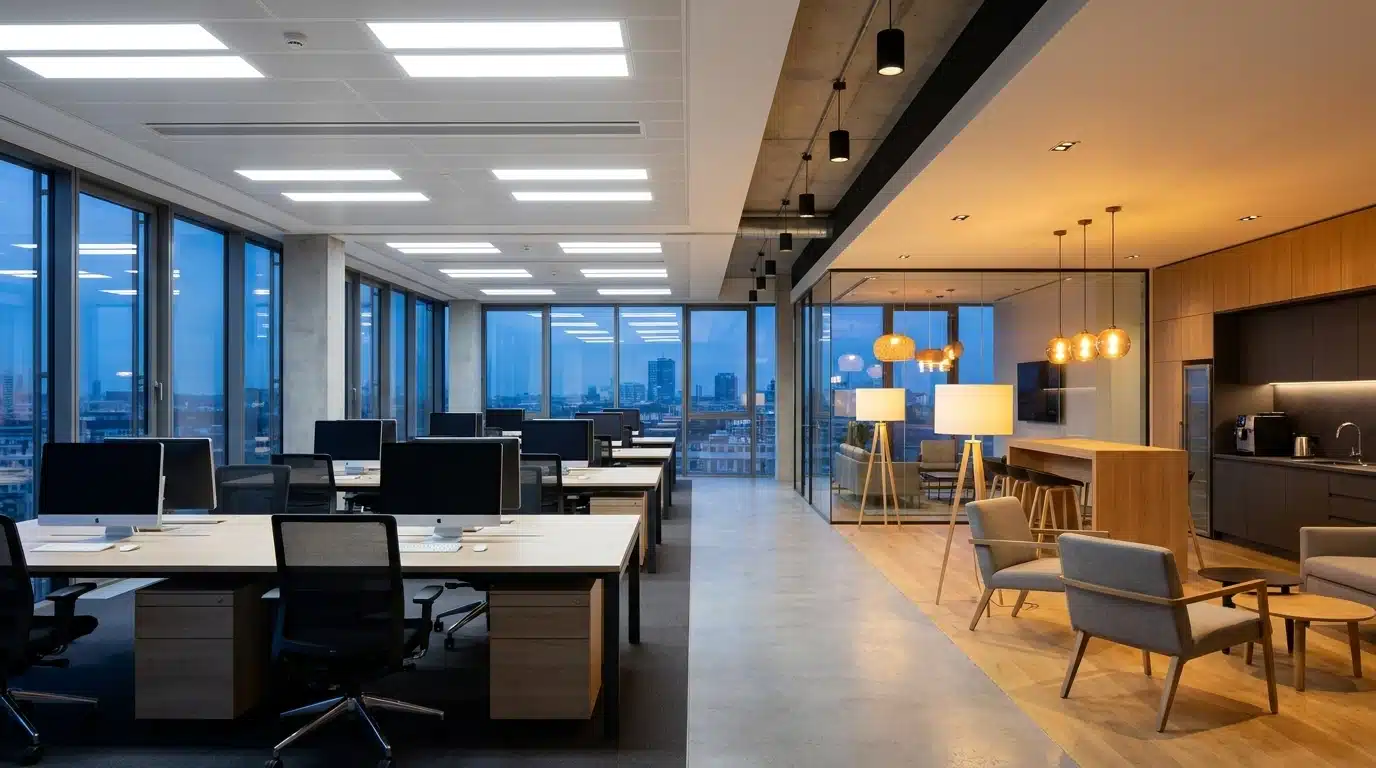

Since the 8th Edition of the Florida Building Code became mandatory on December 31, 2023, commercial developers and architects in Tampa must integrate automated, daylight-responsive lighting controls into most office designs. Under Section C405.2.4 of the Florida Energy Conservation Code, these automated systems are now a legal requirement, moving projects away from manual switches to prevent energy waste and ensure compliance.
As a licensed commercial electrical contractor in Tampa, Suncoast Power helps design teams navigate these technical mandates. Properly integrated lighting networks protect projects from failed electrical inspections and costly delays during the certificate of occupancy phase.
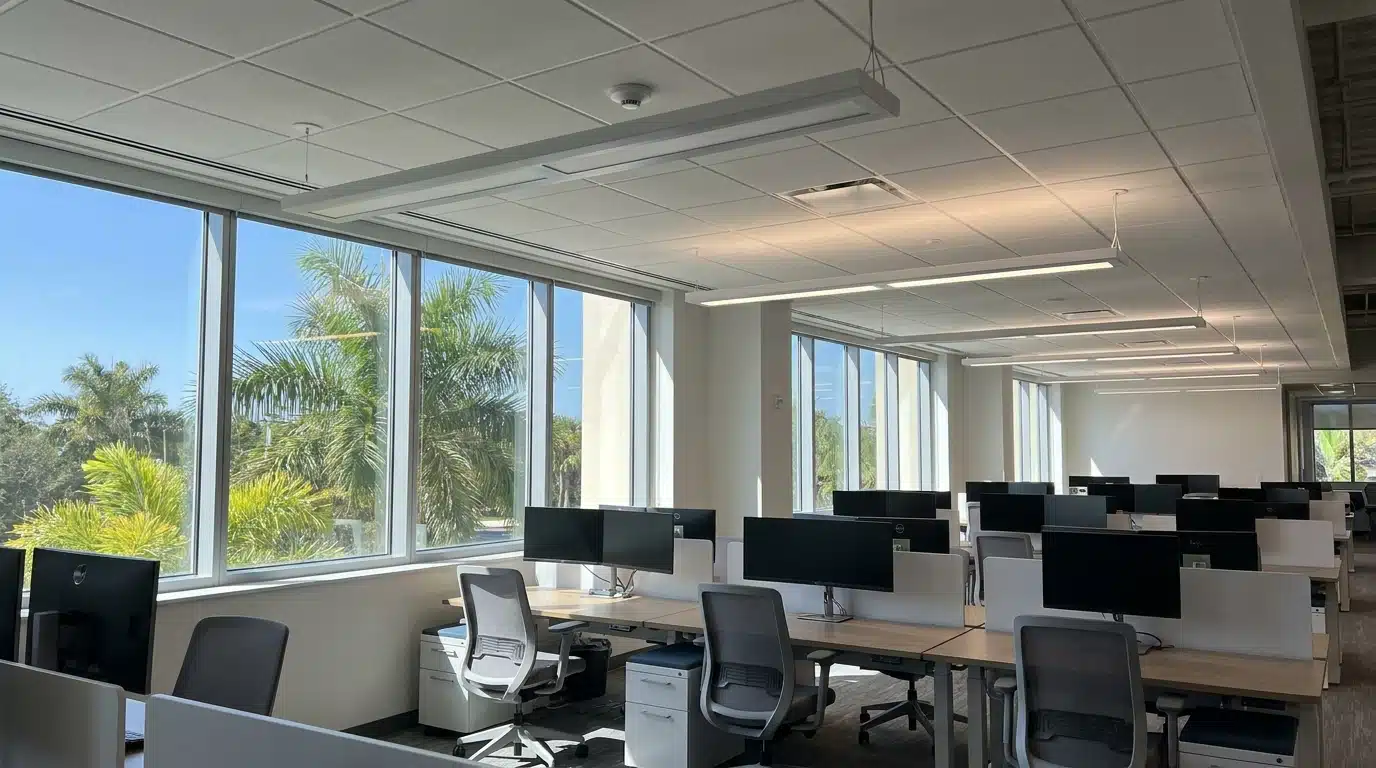
Florida Building Code Requirements for Daylight Responsive Controls
Under the 8th Edition, compliance requires a complete shift from localized manual switches to smart daylight harvesting networks. Meeting the state’s Energy Conservation Code ensures your electrical design passes plan review and final building inspections.
Defining Automated Daylight Harvesting in Modern Offices
Daylight harvesting is an automated strategy where photoelectric sensors (photocells) continuously monitor ambient natural light and signal dimmable LED drivers to reduce artificial illumination in real time. This system maintains a steady target light level, reducing electrical energy consumption and peak grid demand while leveraging Florida’s abundant solar irradiance to provide consistent, comfortable illumination.
Understanding Florida Energy Conservation Code Daylighting in the 8th Edition
With the adoption of the 8th Edition Florida Building Code, Energy Conservation (effective December 31, 2023), Section C405.2.4 regulates mandatory daylighting and responsive controls for all new commercial office construction and major renovations. These rules align Florida’s energy targets with the International Energy Conservation Code. Under these guidelines, design teams must document and verify compliant lighting zones to satisfy local permitting and inspection authorities.
Failing to coordinate these requirements during the initial design phase can prevent a project from securing a certificate of occupancy. Suncoast Power recommends conducting early-stage coordination reviews among the project architect, mechanical engineer, and electrical contractor to ensure seamless alignment of the electrical blueprint.
The Role of Photoelectric Sensors and Continuous Dimming
The hardware relies on photoelectric sensors (photocells) that monitor ambient light levels inside a designated daylight zone. Rather than using abrupt stepped transitions, Section C405.2.4.1 mandates continuous dimming. The system must automatically and smoothly reduce lighting power from full power to 15% or lower.
To achieve this, dimmable LED drivers in office spaces interpret low-voltage sensor signals to adjust the electrical current to the LED fixtures. This maintains a steady, occupant-friendly foot-candle level on work surfaces throughout the day without sudden visual shifts or distractions.
When are Daylight Responsive Controls Mandatory?
Under the Florida Building Code, mandatory daylight-responsive controls are triggered by specific lighting power thresholds, spatial orientations, and the scale of electrical renovations.
The 150W Threshold for Commercial Spaces
Under Section C405.2.4, daylight-responsive controls are mandatory for any space containing more than 150 watts of general lighting within a primary sidelit or toplit daylight zone. Because modern commercial LED fixtures operate at high lumens-per-watt efficiencies, even a small perimeter office with just two or three high-efficacy luminaires will easily exceed this 150-watt threshold.
This requirement also applies to building renovations and tenant improvements. Under Section C503.5, if an alteration replaces 10% or more of the luminaires within a space, the new lighting system must be fully code-compliant, helping to modernize older Tampa office spaces to meet current efficiency standards.
Continuous Dimming and Complete Shutoff Mandates
In offices and classrooms, Section C405.2.4.1 mandates continuous dimming controls that smoothly scale light output from full power down to 15% or lower. This continuous transition prevents abrupt, distracting steps in illumination as daylight levels shift.
Additionally, the daylighting controls must be capable of complete shutoff when natural daylight exceeds the design illuminance target, maximizing energy conservation during periods of peak solar irradiance.
Mapping the Zones: Sidelit and Toplit Design Specifications
Mapping a daylight zone requires precise geometric calculations coordinated between the architect and electrical engineer. Drawing on our three decades of fieldwork in Tampa, we find that incorrect sensor placement within these defined boundaries is the single most common cause of failed electrical inspections.
Calculating Sidelit Zone Boundaries
Under Section C405.2.4.2, the sidelit daylight zone is split into primary and secondary zones. The primary sidelit zone extends laterally (into the room) from the window glass to a distance equal to the height from the floor to the top of the fenestration (window head), and longitudinally (along the wall) from the edge of the fenestration to the nearest full-height wall or up to 2 feet, whichever is less. The secondary sidelit zone begins at the edge of the primary zone and extends laterally up to twice the fenestration height from the floor to the top.
Failure to map these zones accurately can lead to fixtures being placed on the wrong circuits. This complicates the inspection process and may require expensive rework. Proper mapping ensures that the appropriate sensor and logic controller control every fixture.
Toplit Daylight Zones: Skylights and Rooftop Monitors
Toplit daylight zones are common in deep-plan office spaces where vertical windows cannot reach the building’s center. These zones are created by skylights and rooftop monitors that bring sun directly into the core of a structure. Both sidelit and toplit categories are treated differently because the angle and intensity of light vary.
Specifically, the toplit zone extends laterally and longitudinally beyond the edge of the skylight or roof fenestration to the nearest obstruction that is taller than 0.7 times the ceiling height, or to 0.7 times the ceiling height, whichever is less.
Architects must also consider specific glare-control rules for the diffusers used in these systems. These regulations ensure that the natural light provided is high quality. It prevents uncomfortable hotspots or reflections on computer screens that can hinder employee productivity.
Zoning and Circuitry: Keeping Directions Separate
The Florida Building Code mandates that sidelighted daylight zones facing different cardinal orientations must be controlled independently. For instance, a north-facing zone cannot be on the same control group as an east-facing zone. Their light levels vary throughout the day depending on the sun’s position.
Specifically, sidelit daylight zones facing any of the cardinal orientations (within 45 degrees of north, east, south, or west) must be managed separately. These strict orientation mandates directly impact the design of electrical panel boards and wiring paths. However, Section C405.2.4.1 provides a key exception: up to 150 watts of lighting in a single space may be controlled together with a daylight zone facing a different cardinal orientation, allowing for more flexible and cost-effective circuiting.
Engineers must carefully organize the electrical blueprints to ensure each orientation has its own dedicated sensor. Independent zoning prevents the system from dimming lights in a shaded area simply because another part of the building receives direct sunlight. Employees sitting in the shade won’t suddenly find themselves in the dark just because the lobby is flooded with afternoon sun.
Technology Deep-Dive: Wiring and Control Systems
The execution of a compliant daylighting strategy depends on a deep understanding of electrical architecture. Choosing the right wiring topology is essential for a reliable, easy-to-maintain system. Our commercial electrical contractor services ensure that your hardware selection meets both code and operational goals.
Wiring Configurations and Dimmable Drivers
Closed-loop sensors require highly precise interior ceiling placement (typically located at a distance from the fenestration equal to one to two times the window height) to ensure they measure combined illumination without direct glare from local fixtures. Open-loop sensors are placed near the window aperture, facing outward to measure daylight contribution exclusively. Conducting physical pre-wire audits prevents interference from mechanical ducts, structural columns, or architectural elements that create false shadows and cause erratic light cycling.
Analog 0-10V dimming remains the commercial baseline, using dedicated low-voltage class 2 wiring to deliver a variable DC signal to dimmable LED drivers. For advanced multi-tenant floor plans, digital addressable protocols such as the Digital Addressable Lighting Interface or wireless mesh systems offer software-defined zoning. This digital architecture allows facilities to reconfigure daylight zones and adjust dimming curves via software, eliminating the labor cost of physical rewiring during future tenant build-outs.
Luminaire Level Lighting Controls
Section C405.2 provides a streamlined compliance pathway through Luminaire-Level Lighting Controls. By embedding an individual occupancy sensor and photocell directly into each fixture, LLLCs eliminate the need for centralized low-voltage wiring and external logic controllers.
Each LLLC fixture must be independently capable of occupant sensing, daylight harvesting, and wireless configuration of parameters like high-end trim and dimming speed. While the individual fixtures have a higher material cost, they dramatically lower labor hours and wire-run complexity, making them highly cost-effective for retrofits and complex open-office layouts.
Maintenance and Troubleshooting for Commercial Daylight Controls
Post-installation maintenance is vital for preventing system drift and user complaints. Airborne dust and debris on photocell apertures can block light, causing the system to underestimate daylight levels and leave artificial fixtures at full power. Suncoast Power recommends cleaning sensor lenses annually with a non-abrasive, dry microfiber cloth.
Additionally, facility teams must watch for “hunting” (rapid, rhythmic dimming and brightening), which occurs when a sensor is misaligned and responds to the fixture’s output. Technicians should conduct annual calibration checks to account for natural LED lumen depreciation and verify that the target foot-candle setpoints align with the space’s actual task requirements.
A Comparison of Wired vs. Wireless Daylight Harvesting Systems
To help developers choose the optimal infrastructure, the table below highlights the practical trade-offs between traditional wired controls and modern wireless platforms:
| Operational Metric | Wired Systems (0-10V / DALI) | Wireless Systems (RF Mesh Networks) |
| Initial Labor & Installation | Higher labor costs due to extensive conduit and low-voltage Class 2 wire runs. | Lower labor costs; eliminates physical control wiring behind walls. |
| Material Cost | Lower per-unit component cost for analog drivers and basic sensors. | Higher per-unit cost for integrated RF nodes and smart sensors. |
| Zoning & Reconfiguration | Rigid. Changes to physical zones often require manual rewiring at electrical panels. | Highly flexible. Zones are mapped using software and can be easily reconfigured for tenant modifications. |
| Reliability & Signal Drift | Immune to radio-frequency interference; highly stable over long distances. | Requires careful layout planning to bypass concrete, metal studs, or localized RF interference. |
The Financial Case: Return on Investment and Leadership in Energy and Environmental Design Alignment in Florida
With over 230 sunny days per year in Tampa, daylight harvesting translates directly to immediate operational savings. Incorporating these controls reduces lighting-related energy consumption by 15% to 40% and lowers localized heat gain from luminaires, thereby reducing cooling loads on HVAC systems.
For developers pursuing green certifications, daylighting compliance directly supports key credits under LEED v4.1:
- Energy and Atmosphere: Contributes to the “Optimize Energy Performance” credit by documenting reductions in lighting power density.
- Indoor Environmental Quality: Aligns with the “Daylight” and “Quality Views” credits, improving occupant comfort and commanding higher lease premiums in competitive markets.
Typical payback periods range between two and four years, transforming a compliance mandate into a long-term commercial asset.
Commissioning and Functional Testing
The Florida Building Code requires a strict post-installation verification process known as commissioning. FBC Section C408.3 mandates functional testing of all new commercial lighting control systems before final inspection. Functional testing ensures that the hardware operates according to the engineer’s intended sequence of operations.
Required Documentation for the Commissioning Report
To pass inspection under FBC Section C408.3, a registered design professional or approved commissioning agency must execute functional testing and deliver a formal report. For daylight-responsive controls, Section C408.3.1.3 requires specific, documented verification steps:
- Calibration Verification: Confirming that sensor setpoints and locations align with the approved construction documents.
- Continuous Dimming Range: Verifying that the controlled fixtures dim smoothly down to 15% (or lower) of full power.
- Complete Shutoff: Testing that the system shuts off the controlled luminaires completely when ambient daylight exceeds the target setpoint
A signed and sealed Commissioning Report must be provided to the building owner and made available to the local Tampa building official before the final electrical inspection. Without this certified proof, a certificate of occupancy will not be issued.
Common Pitfalls in System Calibration
In our commissioning work, we frequently encounter installation errors that cause functional testing failures:
- Optical Looping: Placing an indoor closed-loop photocell directly in the cone of illumination of a fixture it controls. This creates an oscillating feedback loop of continuous dimming and brightening.
- High-Reflectance Interference: Failing to calibrate sensors for highly reflective interior finishes (such as polished concrete or glass desks) that bounce concentrated light upward, triggering premature dimming.
- Inadequate Burn-In: Failing to perform the manufacturer-recommended burn-in period (typically 100 hours of continuous operation) for new dimmable LED or fluorescent lamps before active sensor calibration, resulting in unstable light output.
Transitioning to the 9th Edition 2026 Forecasts
The upcoming 9th Edition of the Florida Building Code (scheduled to take effect on December 31, 2026) will align with the 2024 IECC, introducing significantly stricter lighting-control thresholds. The current 150-watt load limit for mandatory daylight controls in primary sidelit and toplit zones will be reduced to 75 watts, and the combined primary and secondary sidelit threshold will drop to 150 watts.
To future-proof new office layouts under the 9th Edition, design teams should now specify addressable, software-controlled LED networks. Implementing these highly configurable digital platforms ensures that compliance adjustments can be managed via simple software updates rather than costly physical rewiring when the new rules take effect.
Upgrade Your Office Lighting with Suncoast Power
Designing office spaces to meet Florida’s strict energy standards requires a proactive approach. Properly integrating code-compliant daylight-responsive controls reduces long-term operational costs, avoids regulatory bottlenecks during permitting, and ensures a high-quality visual environment for commercial occupants.
Suncoast Power brings over 40 years of experience to every project in Tampa and across the state. We specialize in the complex wiring and commissioning processes that turn code requirements into high-performance electrical systems.
Contact us today to schedule a design review or consult on your next commercial lighting control installation project in the Tampa Bay area.