





Hospital administrators and IT directors view the decision to invest in high-bandwidth commercial cabling as a core matter of long-term fiscal responsibility. As modern healthcare data demands surge, evaluating the Cat6a ROI becomes a necessary step for maintaining clinical uptime and avoiding the high costs of future retrofits.
Upgrading structured cabling in a live hospital requires balancing upfront capital expenditure against long-term operational efficiency. For a facility looking over a typical 15- to 20-year building life-cycle, selecting the right physical layer standard prevents premature infrastructure obsolescence and ensures uninterrupted patient care.
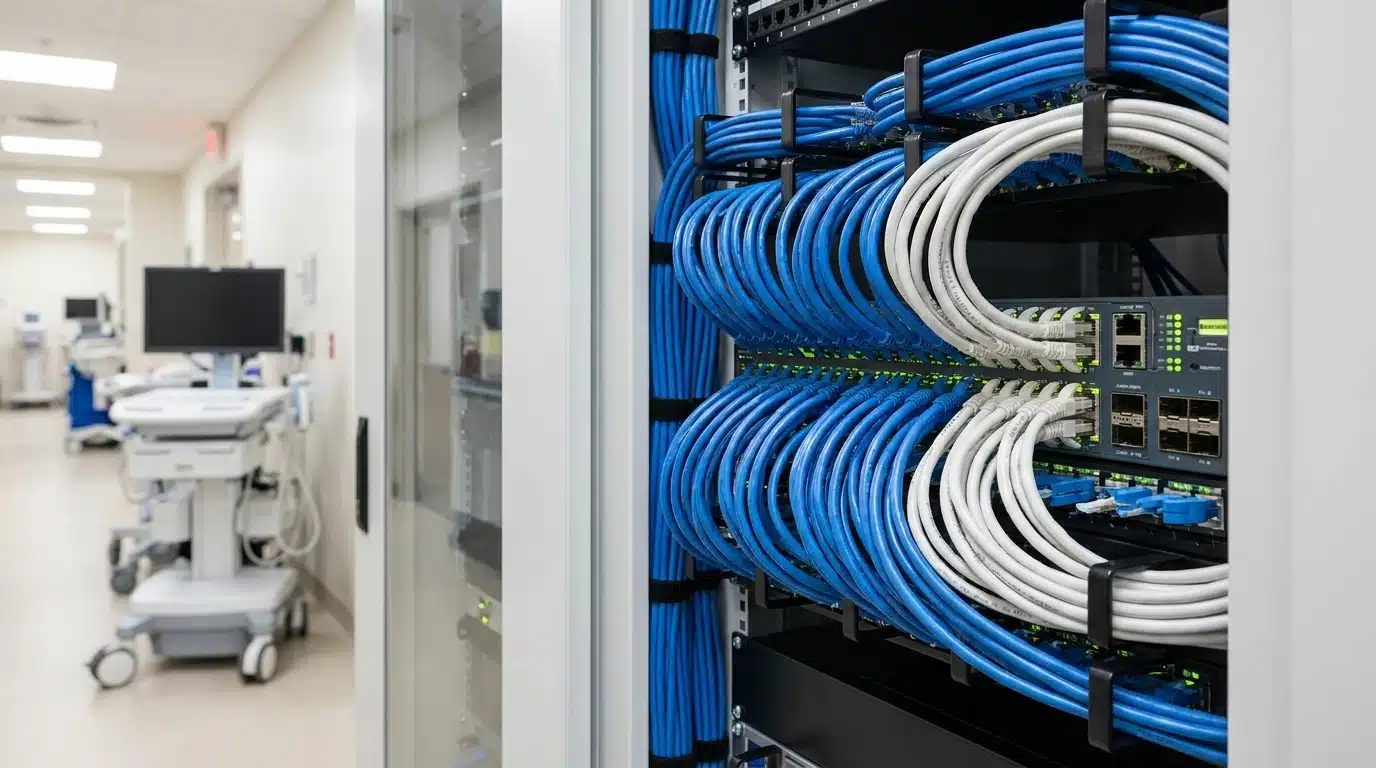
Drivers of Medical Facility Network Upgrades: Data Strain and Bandwidth Requirements
As clinical workflows digitize, legacy cabling systems are being pushed beyond their design limits. Three primary technological drivers necessitate high-capacity physical infrastructure in modern healthcare environments.
High-Resolution Imaging and PACS Data Transfer Demands
High-resolution imaging systems create high-capacity files that quickly saturate local network pathways. With uncompressed Digital Breast Tomosynthesis study sizes ranging from 450 MB to 3 GB, hospitals rely on robust 10 Gbps networks to maintain diagnostic velocity and avoid screen freeze on PACS workstations. Picture Archiving and Communication Systems, or PACS, heavily depend on uncompressed data transfers to maintain image quality. When ultra-high-definition surgical video streams and Digital Imaging and Communications in Medicine image transfers compete for limited bandwidth, clinicians face delays that directly impact patient care.
Legacy cabling like Cat5e or standard Cat6 often creates bottlenecks during the busiest hours of the day. These limitations force specialists to wait for large files to buffer or download. Upgrading to a 10-Gigabit-capable physical layer eliminates these transmission bottlenecks, reducing PACS retrieval latency from minutes to seconds.
Proliferation of Connected IoT Medical Devices and Telemedicine
The Internet of Medical Things has introduced an explosion of networked clinical assets, from bedside biometric sensors to automated pharmacy dispensers, directly into the hospital environment. Smart beds and continuous patient telemetry monitors provide constant updates to Electronic Health Record systems. These tools work alongside automated infusion pumps and handheld diagnostics to create a seamless flow of patient data.
Telemedicine platforms also demand significant network resources to maintain high-definition video feeds. Real-time remote consultations and virtual ICU monitoring require zero-latency connections to ensure clinical accuracy. Any disruption in connectivity can lead to video pixelation or lost telemetry data, which increases operational risk.
Inadequate structured cabling leads to alien crosstalk and packet loss under heavy parallel transmission. This degradation results in TCP retransmissions, jitter in telemedicine video streams, and delayed telemetry synchronization.
Wi-Fi 6E/7 Access Point Bottlenecks and High-Wattage PoE Requirements
Modern wireless infrastructure depends on a high-performance wired backbone to function at its full potential. Advanced access points utilizing Wi-Fi 6E and Wi-Fi 7 standards require multi-gigabit copper uplinks to avoid performance throttling. Standard 1 Gbps connections are no longer sufficient to support the density of devices found in modern hospital settings.
Under the IEEE 802.3bt Type 4 standard, Power over Ethernet delivers up to 90W of power (with 71.3W available at the device) to hardware like multi-axis pan-tilt-zoom cameras, smart building controllers, and motorized access control systems. This continuous current introduces thermal buildup inside closed cable bundles.
Cat6a cabling typically utilizes 23 AWG solid copper conductors, which offer significantly lower DC resistance and superior heat dissipation compared to thinner-gauge legacy alternatives. Under the TIA TSB-184-A guidelines, a bundle of Cat6a cables can safely support up to 101 cables in open air while keeping temperature rise within the recommended 15°C limit under 1000mA per pair (Type 4 PoE) loads, compared to a limit of only 82 cables for Cat6.
Cat6 vs. Cat6a: Technical Superiority for High-Traffic Clinical Environments
Bandwidth and Distance Comparison: Standard Cat6 vs. Augmented Category 6
The technical divergence between standard Category 6 and Augmented Category 6 centers on bandwidth capacity and speed-over-distance metrics. Cat6a is engineered to support 10GBASE-T data transmission speeds over the full 100-meter channel length at a frequency of 500 MHz. In contrast, standard Cat6 is physically limited to 10 Gbps transmission only up to 55 meters under ideal, low-noise conditions, and operates at a maximum bandwidth of 250 MHz.
While standard Cat6 is suitable for low-density commercial offices, high-traffic clinical environments require more robust technical specifications to maintain 24/7 reliability. In medical settings where network downtime directly compromises patient safety, Cat6a provides the performance margins necessary to prevent alien crosstalk and signal degradation.
Long-Term ROI and Life-cycle Cost Analysis
When analyzing return on investment, healthcare CFOs must distinguish between day-one material costs and total life-cycle costs. While a Cat6a cabling system commands a 15% to 25% premium on raw materials over standard Cat6, the installation labor, pathway hardware, and system certification costs remain virtually identical. Because labor and pathways comprise roughly 70% to 80% of any structured cabling budget, the total project premium for Cat6a is usually limited to a marginal 5% to 10% increase.
Over a 20-year building life-cycle, a legacy Cat6 installation will inevitably face a ‘rip-and-replace’ cycle as next-generation medical imaging, Wi-Fi 7 uplinks, and high-density IoMT telemetry outpace its 1 Gbps capability. The financial return of Cat6a is realized by avoiding this secondary, highly disruptive construction phase, which requires repeating pathway licensing, labor costs, and operational downtime.
Mitigation of Interference in Shielded Systems
Medical facilities are harsh electromagnetic environments due to the presence of heavy diagnostic equipment. MRI suites, X-ray machines, and surgical lasers all generate electromagnetic interference. Such electromagnetic noise can disrupt data signals as they travel through adjacent cable bundles in dense trays.
High-traffic hospital pathways run dense cable bundles containing hundreds of runs, creating a high-risk environment for alien crosstalk. To counter this, Cat6a is commonly deployed in shielded configurations (F/UTP or S/FTP). This metallic foil shielding effectively blocks electromagnetic interference and radio frequency interference generated by nearby high-power diagnostic equipment, including MRI scanners and X-ray systems, ensuring clinical data packet delivery remains error-free without signal retransmission delays.
Financial Analysis: Initial Capital Expenditure vs. Long-Term Value
Healthcare financial executives must carefully evaluate the initial capital expenditure of a network upgrade against long-term value. While the upfront costs of Cat6a are higher, the cumulative savings over several years are significant. A thorough financial review helps committees understand how today’s spending prevents future expenses.
Line-Item Cost Breakdown of Structured Cabling Upgrades
A comprehensive structured cabling overhaul includes several specific cost components that budget planners must track. These items include the raw cable materials, high-performance patch panels, and specialized RJ45 jacks. The budget must also account for cable pathway containment systems and the labor required for a complex installation.
Certified low-voltage electricians provide the specialized labor needed to install and test these systems correctly. Post-installation testing ensures that every run meets the required performance standards. While Cat6a materials are more expensive than Cat6, they typically represent only 20% to 30% of the total project budget.
| Cost Component | Standard Cat6 Share (%) | Augmented Cat6a Share (%) | Key Budgetary Impact / Explanation |
| Bulk Cable & Connections | 15% | 22% | Premium for 23 AWG solid copper, internal spline, and shielding. |
| Pathways & Containment | 10% | 12% | Larger diameter requires slightly larger conduit fill or tray capacity. |
| Specialized Labor (ICRA) | 65% | 58% | Constant costs for containment tents, HEPA filtration, and pull labor. |
| Testing & Certification | 10% | 8% | Fluke DSX testing is required for both to obtain manufacturer warranty. |
The costs for labor, pathway access, and testing remain largely the same regardless of which cable category is chosen. This means the premium for Cat6a is a relatively small portion of the total investment. Investing in the better material provides a higher level of performance for a marginal increase in the overall project cost.
Calculating Total Cost of Ownership and Life-Cycle Savings
Total Cost of Ownership models for Cat6a span a fifteen- to 20-year building life-cycle. Installing standard Cat6 often results in a premature rip-and-replace project within five to seven years. Premature obsolescence happens as the demands of wireless access points and imaging systems quickly exceed the 1 Gbps limit of older cabling.
Cat6a future-proofs the facility’s physical layer by supporting higher speeds from the start. Health systems can upgrade their active switch hardware and endpoint equipment multiple times without touching the cabling in the walls. Future-proofing the physical layer saves significant money by avoiding the labor costs of repeated cable installations.
The longevity of Cat6a makes it a more cost-effective choice when viewed over the life of the building. It allows IT departments to scale their network capabilities as technology evolves. Avoiding the disruption of a second cabling project is a major component of long-term financial savings.
Localized Considerations for Florida Healthcare Facilities
Healthcare facilities in Florida must design physical layers to withstand unique environmental stressors. High ambient humidity and condensation in unconditioned plenum spaces can accelerate insulation degradation. To mitigate this, installations should utilize CMP (Plenum-rated) Cat6a cables jacketed with high-grade Fluorinated Ethylene Propylene, ensuring compliance with NFPA 90A and the Florida Building Code’s strict fire-safety and smoke-emission standards. Additionally, local coastal environments expose conduits to salt-air corrosion, which requires corrosion-resistant, powder-coated cable trays and sealed conduit fittings.
Retrofitting Challenges in Active Clinical Environments
Conduit Space and Bend Radius Constraints for Larger Diameters
Retrofitting active medical facilities requires addressing physical layer constraints. Cat6a cables feature an outside diameter ranging from 0.28 to 0.35 inches, compared to standard Cat6 at approximately 0.22 inches. This larger diameter significantly reduces conduit fill capacity under National Electrical Code (NEC) Chapter 9, Table 1 (which limits conduit fill to 40% for three or more cables). In addition, Cat6a requires a larger minimum bend radius (typically four times the outer diameter) to prevent signal degradation from physical stress on the twisted copper pairs, demanding careful pathway routing around tight corners.
Mitigating Labor Overhead and Disruption in Legacy Conduits
Installing thicker cabling in congested plenum spaces increases pulling tension and labor hours. However, this capital outlay is a one-time expense. If a hospital compromises on standard Cat6 to simplify an initial installation, they will face identical labor costs and operational disruption a few years later when that cable fails to support 10GBASE-T bandwidth. Selecting Cat6a from the outset guarantees that the physical conduit and pathway investments remain productive for decades.
Operational and Safety Returns: Patient Outcomes and Compliance
The technical capabilities of Cat6a have a direct impact on clinical workflows and patient safety. Better network performance leads to faster diagnostic cycles and more reliable communication between departments. These improvements contribute to better patient outcomes and help maintain compliance with strict healthcare regulations.
Enhancing Clinical Workflow and Diagnostic Velocity
By delivering 10 Gbps speeds, Cat6a channels allow immediate retrieval of uncompressed multi-slice scans. This reduces critical PACS loading latency from up to 30 seconds down to sub-second speeds, enabling emergency department clinicians and stroke teams to review imaging and initiate interventions without delay.
When medical staff access data without waiting for buffering screens, they make faster decisions. Those saved seconds can be life-saving in acute care scenarios.
Safeguarding HIPAA Compliance and Patient Data Integrity
Regulatory compliance under the Health Insurance Portability and Accountability Act requires secure, reliable data transmission. Poor signal integrity or packet corruption can lead to the loss of electronically protected health information. If data is corrupted during transit, it can create compliance vulnerabilities that lead to significant fines.
Shielded Cat6a cabling preserves end-to-end data integrity by eliminating packet corruption caused by alien crosstalk (ANEXT) and external electromagnetic interference. Grounded shielding systems (F/UTP or S/FTP) ensure that critical patient telemetry and diagnostic transmissions reach the core network without loss, supporting HIPAA’s technical safeguard requirements for secure, uninterrupted transmission of electronic protected health information.
Maintaining the privacy and accuracy of patient records is a top priority for any healthcare organization. A high-quality cabling system ensures that data moves securely from the point of care to the data center.
Minimizing Operational Disruption with Infection Control Protocols
Cabling upgrades in active clinical environments carry operational risks related to infection control. Low-voltage contractors must adhere to strict Infection Control Risk Assessment Class III or Class IV protocols when accessing plenum spaces in active clinical wings. This mandates the use of negative-pressure containment carts, HEPA-equipped air scrubbers, and continuous dust monitoring to prevent the aerosolization of fungal spores and safeguard immunocompromised patients.
Performing these upgrades in a live hospital is a complex and expensive process. By investing in Cat6a once, a facility avoids the need for repeated ceiling disruptions in the future. Avoiding the repeated renovations protects vulnerable patients from airborne pathogens that could be released during construction activities.
Reducing the number of times a contractor must enter patient areas also prevents costly facility closures. Maintaining cleanroom integrity is a primary requirement for surgical suites and high-risk wards.
Strategic Capital Planning Framework for Healthcare Executives
Healthcare administrators can use a strategic framework to manage the budgeting and execution of network upgrades. This process begins with an honest assessment of current capabilities and future needs. A structured approach ensures that the project remains on track and delivers the expected return on investment.
Conducting a Site Assessment and Infrastructure Audit
The planning phase of a network migration requires a comprehensive site assessment and physical layer audit. IT teams must calculate current conduit fill ratios under NEC standards and conduct Time Domain Reflectometry testing to map the physical integrity of existing runs. This audit identifies localized bottlenecks, physical path degradation, and spaces where existing J-hooks or trays must be upgraded to support heavier cable bundles.
Establishing an accurate baseline prevents budget overruns by identifying route blockages and structural constraints before procurement. These audits help IT leaders prioritize upgrades, targeting high-density zones like PACS imaging hubs, ICU telemetry nodes, and data centers before extending the upgrade to administrative wings.
Understanding the current state of the network allows planners to set realistic goals for the project. It ensures that the new cabling will integrate seamlessly with existing building systems.
Phased Deployment Models for Live Medical Facilities
To ensure zero clinical downtime, structured cabling modernizations should utilize a phased deployment strategy. Work is scheduled during low-traffic maintenance windows—typically 11:00 PM to 5:00 AM—or coordinated with planned departmental renovations. This ensures critical diagnostic and inpatient services remain uninterrupted throughout the transition.
Cat6a is backward compatible with legacy RJ45-based hardware, facilitating a hybrid migration where high-priority wings are upgraded first. This staggered approach helps spread capital expenditure across multiple budget cycles while ensuring high-demand areas immediately meet the TIA-1179-A standard for healthcare telecommunications infrastructure.
Moving through the facility in stages reduces the burden on IT staff and minimizes the risk of widespread outages. It allows the team to test and verify each new section before moving to the next. We follow the TIA-1179-A standard to ensure medical environments remain future-proof.
Questions for Your Low-Voltage Electrical Contractor
Selecting the right partner requires a deep understanding of their technical and safety qualifications. Before signing a contract, ensure you ask specific questions regarding their experience with healthcare-specific requirements. The following topics should be part of your procurement phase:
- Can you provide proof of active BICSI RCDD (Registered Communications Distribution Designer) and certified low-voltage technicians on your staff?
- What specific containment systems (e.g., negative pressure HEPA carts) do you deploy to comply with ICRA Class III and IV guidelines in active clinical corridors?
- Will you deliver full Fluke DSX-8000 certification reports verifying insertion loss, NEXT, and PS-ANEXT for every individual drop?
Contractors must demonstrate extensive experience in remote power engineering to prevent heat-rise failures. Ensuring the contractor designs and tests the system in strict compliance with the IEEE 802.3bt specifications protects your active network hardware from premature port degradation and cabling impedance mismatches.
Schedule An On-Site Audit With Suncoast Power
Upgrading to Cat6a structured cabling provides a clear path toward improved network performance and financial efficiency. Cat6a infrastructure supports high-bandwidth medical technologies and meets the strict requirements of established industry standards. By future-proofing your facility, you can reduce long-term costs and enhance patient care through reliable, high-speed connectivity.
Suncoast Power specializes in designing and installing the robust electrical and low-voltage systems modern medical facilities require. We provide expert design, precise installation, and full system certification to ensure your infrastructure meets the highest standards. Contact us today to learn how our low-voltage solutions can support your facility’s long-term growth and operational reliability.