





Large, open-plan offices often waste significant energy when lighting remains on in completely unoccupied areas. This constant illumination drives up utility costs and places an unnecessary strain on the building's electrical infrastructure. It's common to see vast floors fully lit well after business hours simply due to a lack of automated controls.
Budget-conscious facility managers are increasingly turning to occupancy sensors to reduce electricity consumption and meet modern energy codes. While initial installation and wiring costs can be a concern, understanding the structural and financial aspects of low-voltage relay cabling, ceiling plenums, and advanced sensor technologies offers highly cost-effective pathways for commercial energy-efficiency retrofits. Understanding the mechanics of these systems is the first step toward hardening your building's defenses against rising energy costs.
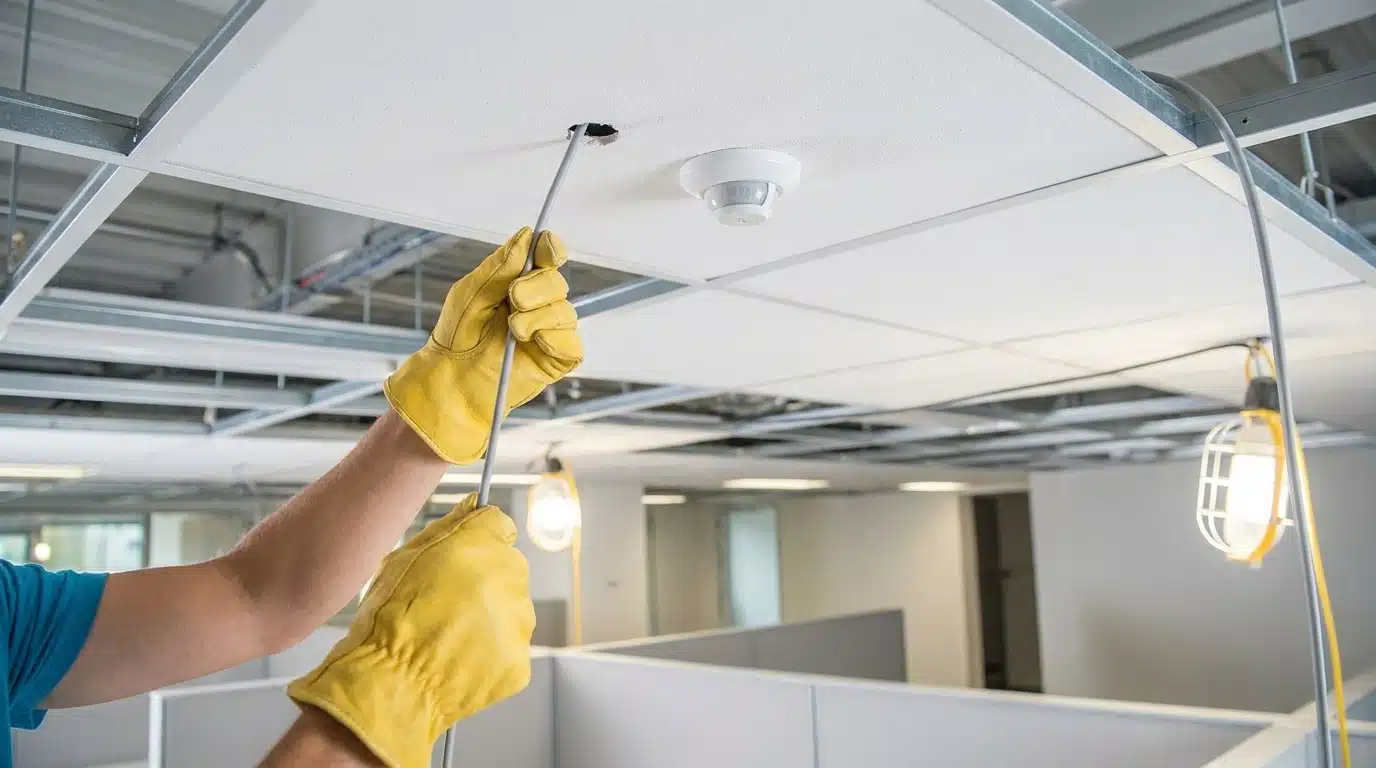
Why Upgrading Office Lighting Controls Makes Financial Sense
Understanding the financial incentives behind installing lighting controls is necessary before diving into the technical aspects of cabling. Facility managers must consider hidden energy waste, regulatory compliance, and overall return on investment when planning an electrical retrofit.
The Hidden Costs of Inefficient Office Lighting
Commercial buildings often leave lights on for hours in vacant conference rooms, break rooms, and vast open office layouts. This continuous and unnecessary lighting leads to peak demand charges and inflated electricity bills that quietly drain operational budgets. Occupancy sensors help businesses activate lights only when people need them, saving money and benefiting the environment.
Traditional fluorescent lighting fixtures or manually controlled wall switches rely entirely on human intervention, which is notoriously unreliable in a busy corporate environment. It’s common for the last person leaving a room to forget to turn off the switch, leading to hours of wasted power. These inefficiencies accumulate across thousands of square feet, creating a documented 30% to 60% increase in lighting-related energy expenditures.
These hidden costs erode a company’s bottom line over time, making a strong financial case for automated controls. Selecting the right office lighting controls requires a balance between initial hardware costs and the long-term labor savings of low-voltage relay cabling. This transition from manual to automated systems eliminates the variability of human behavior.
How Do Energy Codes Impact Lighting Upgrades?
Commercial energy codes play a significant role in driving lighting upgrades across the country. Specific standards such as ASHRAE 90.1 and Title 24 mandate automatic lighting shutoffs and multi-level lighting controls in commercial spaces. ASHRAE 90.1-2013 and IECC 2015 require functions such as local control, daylight-responsive controls, and scheduled shutoff.
In Florida, the 2017 commercial code follows the 2015 IECC model with specific amendments, though it also permits ASHRAE 90.1-2013 as an alternative path. Complying with these codes is legally required for many new construction projects and major retrofits. It establishes a baseline for maximum energy efficiency that all commercial properties should strive to achieve.
ASHRAE 90.1-2013 requires automatic shutoff in many spaces within 20 minutes of all occupants leaving. Staying ahead of these regulatory requirements prevents future fines and standardizes energy-saving practices across the facility. It also prevents the need for expensive, mandated updates later when codes become even more stringent.
The 2015 IECC requires each building space to have a control that reduces lighting power by at least 50%. This reduction ensures that facilities not only save money but also adhere to the strict conservation targets set by state authorities. Achieving these benchmarks requires a professional approach to sensor integration and circuit design.
Calculating the ROI of Occupancy Sensors
Budget-conscious facility managers can calculate the return on investment for occupancy sensors by looking at several key variables. The ROI depends on factors such as the office’s square footage, local utility rates, and the current system’s baseline energy consumption. These calculations provide a clear picture of how quickly the upgrade will pay for itself.
A comprehensive energy audit should calculate payback periods, which often occur much sooner than expected. Many commercial spaces see a complete return on their investment within eighteen months to three years. This timeframe makes the upgrade one of the most attractive capital improvements available for office buildings.
Calculating these figures upfront justifies the initial cost of professional cabling and electrical labor. Demonstrating a clear payback period justifies the capital expenditure by proving the lighting retrofit will reduce monthly operational overhead. Clear financial data helps stakeholders approve projects with confidence.
What Are The Best Occupancy Sensors For Large Offices?
Selecting the correct sensor technology is a primary factor in determining both the system’s effectiveness and the complexity of the required cabling. Understanding passive infrared, ultrasonic, and dual-technology sensors is necessary for optimizing installation costs in complex, partitioned environments.
Passive Infrared (PIR) Sensors
Passive infrared sensors operate by detecting the temperature difference between a moving human body and the background. Their detection capabilities are optimized for 15- to 20-foot mounting heights when they have a direct line of sight to the occupants in the room. This technology is particularly adept at detecting major motion, such as someone walking through a doorway.
These sensors are generally the most affordable option and work best in enclosed spaces like private offices or long, unobstructed hallways. Passive infrared sensors are also most effective in spaces that are often unoccupied, such as warehouses, corridors, and conference rooms. They provide a simple and reliable solution for areas with clear visibility.
Using them in large open-plan offices with tall cubicles can lead to false-offs if occupants are hidden from the sensor’s view. This might require additional units and more extensive wiring to correct, which can drive up the total project cost. Understanding these limitations is important during the design phase.
Ultrasonic Sensors
Ultrasonic occupancy sensors emit high-frequency sound waves and measure the time it takes for those waves to bounce back. This allows them to detect minor movements even behind obstacles like filing cabinets or restroom partitions. Because they don’t require a direct line of sight, they offer superior coverage in complex layouts.
This echolocation functionality makes ultrasonic sensors excellent for commercial environments where line of sight is frequently obstructed. They provide 360-degree volumetric coverage that passive infrared sensors cannot match in dense cubicle layouts. They’re sensitive enough to detect typing or other subtle office tasks across a 1,000-square-foot radius.
While they offer broader coverage, they’re typically more expensive and may require careful placement and wiring. It’s important to ensure they don’t mistakenly trigger in response to HVAC air movement or hallway traffic. Proper calibration is needed to ensure that the high-frequency waves don’t interfere with other equipment.
Dual-Technology Sensors
Dual-technology sensors combine both PIR and ultrasonic detection methods to offer the highest level of accuracy. They usually require both technologies to be triggered before turning the lights on, but only one is needed to keep them active. This hybrid approach leverages the strengths of both methods while minimizing their weaknesses.
This approach virtually eliminates false-offs and false-ons, providing a seamless experience for employees. For large office spaces and computer rooms, dual-technology sensors provide the most reliable performance available on the market. They’re the preferred choice for areas where occupants might remain relatively still for long periods.
The elimination of nuisance switching through signal-correlation logic ensures that workers are never left in the dark. While the upfront hardware cost is higher, the reliability reduces occupant complaints and maintenance adjustments. This makes them a structurally sound choice for comprehensive office retrofits that prioritize long-term performance.
Occupancy vs. Vacancy Modes
Occupancy sensors automatically turn lights on when someone enters and off when they leave, providing maximum convenience for high-traffic areas. These are best used in lobbies, open floors, and restrooms where hands-free operation is a benefit. Automatic-on functionality ensures that no one ever has to enter a dark room.
Vacancy sensors require the user to flip a switch to manually turn the lights on, but they still automatically turn them off once the room is empty. This manual-on approach often generates higher energy savings because lights aren’t activated by someone momentarily walking into a space. It prevents the system from turning on lights when there’s already sufficient natural daylight.
In open offices, vacancy sensors can save more energy than occupancy sensors because they prevent automatic activation from brief movement. ASHRAE 90.1-2013 often pushes many spaces toward manual-on or partial automatic-on operation to maximize efficiency. Choosing between these modes depends on the specific needs of each office zone.
Line-Voltage vs. Low-Voltage Cabling: Which Is More Cost-Effective?
The choice between line-voltage and low-voltage wiring for lighting controls is a high-priority decision for any facility manager. This choice significantly affects the overall labor time, material costs, and structural complexity of the retrofit. A direct cost analysis reveals why the commercial electrical industry is shifting heavily toward low-voltage relay cabling.
The High Costs of Traditional Line-Voltage Systems
Line-voltage systems require sensors to be wired directly into the building’s 120-volt or 277-volt electrical circuits. This electrical setup necessitates running heavy-gauge copper wiring through rigid metallic conduits to meet commercial safety standards. The materials themselves are heavier and more expensive than their low-voltage counterparts.
The process of bending and installing conduit is incredibly labor-intensive and expensive. It requires specialized tools and significantly more time on the job site for every sensor installed. This traditional method often leads to longer project timelines and higher contractor fees.
Modifying these high-voltage systems in the future is also a major hurdle. It requires shutting down power to large sections of the office and hiring specialized commercial electricians, which reduces long-term operational flexibility. These systems are rigid and don’t adapt well to changing office layouts.
The Efficiency of Low-Voltage Relay Cabling
Low-voltage relay cabling is widely considered the most cost-effective solution for large office spaces. These systems use thin, inexpensive cables, such as 18- to 22-AWG, to connect ceiling-mounted sensors to a centralized power pack. The smaller wire size makes the cabling much easier to handle and pull through tight spaces.
When wiring occupancy sensors in a high-density office, contractors must prioritize cable paths that avoid electromagnetic interference from high-voltage lines. Using 18 AWG is the industry standard for minimizing voltage drop over long runs in large office layouts. These cables don’t carry dangerous electrical currents, so they can often be routed safely without heavy-duty conduits.
This flexibility allows for much faster routing through complex ceiling structures. It also means that future modifications can be made with minimal disruption to the building’s infrastructure. Low-voltage motion sensors and power packs can quickly cover large open areas with relatively low installation costs.
Understanding Class 2 Wiring Standards
Navigating the National Electrical Code Article 725 is essential when planning a low-voltage lighting control system. This section of the code defines Class 2 wiring, which covers circuits that are limited in power and voltage to prevent fire and electrical shock hazards. Using Class 2 wiring allows for less stringent installation methods than standard line-voltage circuits.
Because Class 2 power supplies limit the energy output, the associated cabling can often be routed without the heavy protective conduits required for traditional electrical wiring. This distinction fundamentally drives labor savings in modern lighting control retrofits, enabling technicians to install large sensor networks more efficiently and safely.
Comparing Labor and Material Expenses
Skilled labor represents the bulk of the expense in any commercial electrical retrofit. The faster installation times associated with low-voltage systems provide a massive financial advantage. Low-voltage relay cabling typically reduces installation labor by 40% compared to line-voltage conduit runs by eliminating the need for pipe bending.
Class 2 low-voltage systems do require the purchase of additional control components, such as zone controllers, power packs, and solid-state relays. However, the savings realized from buying cheaper cable and eliminating extensive conduit work far outweigh these extra hardware costs. The overall material budget is often lower, even with the extra devices.
For a budget-conscious facility manager overseeing a sprawling office space, low-voltage wiring provides the lowest total cost of ownership. It balances initial capital expenditure with long-term ease of maintenance.
How Do Ceiling Plenums Affect Sensor Wiring Costs?
The space above the drop ceiling, known as the plenum, is frequently used for routing HVAC return air and various types of wiring. Understanding plenum requirements is important for ensuring building safety and passing fire code inspections without incurring unexpected expenses. Failure to comply with these rules can lead to significant structural and financial setbacks.
Understanding Ceiling Plenums in Commercial Buildings
In many commercial buildings, the space between the structural ceiling and the suspended acoustic tiles serves as a major return-air pathway. This architectural design eliminates the need for extensive return ductwork, thereby reducing initial construction costs. It creates a unified environment for air circulation and infrastructure routing.
The plenum space circulates the air that employees breathe throughout the entire floor. Therefore, anything placed within it is subject to intense scrutiny regarding air quality and fire safety. If a fire starts in the plenum, the HVAC system could quickly spread smoke and flames throughout the building.
Occupancy sensor cabling and power packs must meet specific fire-resistance standards for installation in these areas. Anything that isn’t properly rated can pose a hazard in an emergency. Understanding these architectural nuances is a fundamental part of electrical planning.
The Necessity of Plenum-Rated (CMP) Cables
Using plenum-rated cables for low-voltage lighting controls is a safety requirement. Standard PVC-coated cables release toxic smoke and hazardous fumes when burned, which a plenum system would rapidly circulate.
Plenum-rated, or CMP, cables are coated with special fire-retardant materials like Teflon. These materials emit very little smoke and are designed to self-extinguish when the heat source is removed. They’re specifically engineered for use in air-handling spaces where safety is the top priority.
CMP cables cost slightly more per foot than standard cables, but they’re a mandatory safety investment. They allow the legal routing of sensor wires through open ceiling spaces without conduit. Using the correct cable type from the start prevents dangerous situations and legal liabilities.
Avoiding Code Violations and Costly Installation Rework
Commercial building inspectors strictly enforce the use of plenum-rated cables and appropriate fire-rated mounting hardware. Lighting control systems using occupant sensors must be functionally tested and calibrated to pass inspection. This includes confirming that the timeout and sensitivity settings meet the code.
Suncoast Power specifically navigates Florida-specific amendments to ensure projects remain fully compliant with local laws. Attempting to save money by using non-rated wire will result in failed inspections and legal trouble. A failed inspection forces facility managers to rip out and entirely rewire the system at double the labor cost.
Hiring a knowledgeable commercial electrical contractor guarantees that all ceiling plenum cabling is done to code. This protects the project’s budget and ensures the safety of all building occupants. Professional expertise is the best defense against unexpected costs and failed code inspections.
Strategic Cabling Methods For Large Open-Plan Offices
A single sensor or a simple wall switch cannot effectively control large open spaces. Using devices such as power packs, daisy-chained data lines, and dedicated control zones enables scalable, cost-effective infrastructure in large commercial environments. Strategic planning ensures that every part of the office is covered without overspending on materials.
Utilizing Power Packs and Low-Voltage Relays
A power pack serves as the heart of a low-voltage sensor system. It converts high-line voltage into a safe 15 to 24 volts of Direct Current to power remote occupancy sensors.
These devices are typically mounted directly to electrical junction boxes in the ceiling plenum. They intercept the power before it reaches the lighting fixtures, acting as a load controller. This placement keeps the high-voltage components tucked away and the low-voltage wires easily accessible.
By using internal relays, the power pack receives the low-voltage signal from the sensor and switches the high-voltage lighting load. This creates a secure and highly efficient control system that’s easy to install. Power packs can often control multiple sensors, providing a centralized point of operation for large office zones.
Daisy-Chaining Sensors for Maximum Scalability
In large open offices, a single sensor’s coverage area is rarely enough to monitor the entire floor. Multiple devices are often required to ensure every corner of the workspace is properly covered. Coordinating these devices efficiently is key to keeping cabling costs low.
Low-voltage wiring allows contractors to use a cost-saving technique called daisy-chaining. Daisy-chaining involves running a single cable from the power pack and connecting it sequentially through multiple sensors. It’s a much more efficient way to wire a large room than running individual lines for every device.
This method drastically reduces the total linear footage of cable required for the project. It also simplifies future troubleshooting because the wiring path is more direct and logical. Daisy-chaining makes it easier to add or move sensors if the office layout changes in the future.
Creating Strategic Lighting Control Zones
Instead of wiring an entire open office floor to switch on and off simultaneously, fixtures should be cabled into distinct control zones. These zones are typically based on departmental usage and daily traffic patterns. Open-plan office areas larger than 300 square feet may need to be divided into 600-square-foot control zones under IECC 2018.
Localized zoning ensures that only the specific quadrant of the office currently occupied is illuminated. Lighting power in a vacated zone must be reduced by at least 80% under certain newer energy codes. This precision prevents wasting energy on empty desks while people are working in another part of the room.
Strategic zone cabling also prevents excessive wear and tear on LED drivers. Massive grids of lights don’t need to cycle on for a single employee working late at night. Zoning allows the building to adapt its energy consumption to the actual occupancy levels in real time.
Integrating Photocells for Daylight Harvesting
Cabling photocells alongside occupancy sensors can amplify financial savings in modern offices. Daylight harvesting is a strategy where artificial lighting is automatically dimmed when sufficient natural sunlight enters through windows. The 2015 IECC requires daylight-responsive automatic controls in sidelighted and toplighted zones.
Wiring closed-loop photosensors into the low-voltage relay system allows for continuous dimming adjustments. The controls make continuous changes based on real-time environmental conditions throughout the day. A combination of occupancy sensing and daylight harvesting provides the largest savings near windows.
While this adds a minor upfront cabling cost, the cumulative energy savings are significant. Perimeter office spaces achieve a much shorter payback period when daylight harvesting is used. This technology ensures the building makes the most of natural resources while maintaining a comfortable workspace.
Exploring Advanced Cabling and Networked Lighting Controls
Modern commercial lighting is transitioning from simple analog relays to digital networks and smart building integration. Exploring Power over Ethernet, digital communication protocols, and hybrid wireless systems provides budget-conscious operators with future-proof solutions. These advanced methods offer greater flexibility and more detailed energy data.
Utilizing Power over Ethernet (PoE) and Cat5/Cat6 Cabling
PoE technology allows standard Cat5 or Cat6 data networking cables to deliver both low-voltage electrical power and digital communication. This means LED fixtures and occupancy sensors can be powered and controlled through a single cable. It merges the building’s electrical and data infrastructure into a single efficient system.
The financial benefits of this approach are substantial because it eliminates the need for traditional alternating-current wiring in the ceiling. It streamlines the installation process by using familiar networking infrastructure that’s already present in most offices. PoE systems are also inherently safe due to their low-voltage nature.
PoE creates a highly scalable, plug-and-play infrastructure that’s ideal for dynamic corporate environments. It’s much easier to reconfigure workspaces when the lighting and sensors are part of a flexible data network. This technology is a significant step toward creating a truly smart building.
Digital Communication Versus Analog Control Relays
Older analog systems rely on simple voltage triggers to open or close a relay. This limits their functionality to basic on-and-off commands, with little room for nuance. While these systems are reliable, they don’t provide the level of control required by modern energy-conscious businesses.
Digital systems utilize microprocessors and network cables to send specific, addressable commands to individual fixtures. This enables precise dimming, scheduling, and even real-time energy reporting across the entire facility. Facility managers can monitor energy usage from a central dashboard and make adjustments remotely.
Digital network cabling requires a slightly higher initial investment, but offers superior granular control. Integrating these systems with building management platforms yields much higher long-term operational efficiency. The ability to collect and analyze data helps in making more informed decisions about building performance.
Hybrid Wireless Systems With Cabled Power Supply
In some retrofit scenarios, running new communication wires between every fixture is cost-prohibitive. This is often the case in buildings with inaccessible ceilings or complex architectural features. Hybrid systems offer a solution by combining the stability of wired power with the flexibility of wireless control.
Electrical contractors can install sensors that draw low-voltage power from local cabled power packs but use secure wireless mesh networks for communication. This eliminates the need for long data cable runs between devices. It’s a particularly effective way to upgrade older buildings without a major renovation.
This hybrid approach drastically cuts labor and cabling costs while still delivering robust control. It’s an excellent solution for large office floors where traditional wiring paths are blocked or restricted. Wireless technology has advanced to the point where it’s just as reliable as hardwired communication for lighting controls.
Phase-by-Phase Installation Planning for Facility Managers
Planning a large-scale cabling project requires a structured approach to minimize operational disruption. A phased rollout allows the facility to remain active while technicians work in concentrated zones. This strategy ensures that the project moves forward without compromising daily business productivity.
The Discovery and Pre-Installation Audit Phase
The first step involves a comprehensive walk-through of the property to identify existing electrical loads. Technicians map out the current circuit configurations and determine where power packs can be mounted most efficiently. This initial audit prevents unexpected hardware incompatibilities once the physical cabling begins.
During this phase, a checklist should be used to verify the age of existing LED drivers. Mapping HVAC return-air paths in the plenum is also a vital task to ensure fire code compliance. A clear baseline assessment allows for more accurate labor and material projections.
A professional lighting installation estimate should detail fixture-by-fixture labor and any specialized equipment rentals needed for high-ceiling environments. This transparency helps facility managers secure budget approval with data-backed cost justifications. Every hurdle identified during the audit phase is one fewer surprise during installation.
Execution and Technical Commissioning Phase
Once the materials are on-site, the physical routing of low-voltage relay cabling begins in the ceiling spaces. Contractors must follow the engineered paths to ensure that the sensors have the optimal line of sight for detection. Proper cable management techniques, such as using J-hooks, prevent sagging and potential damage to the wire jackets.
After the physical wires are pulled and terminated, the technical commissioning process begins. Each sensor must be functionally tested and calibrated to pass the final building inspection. This includes confirming that the sensors shut off the lights within the required 20-minute inactivity window.
Calibrating the sensitivity thresholds prevents false-ons that could be triggered by HVAC vibrations or outside traffic. This fine-tuning ensures that the system provides the intended energy savings without frustrating the building occupants. A successful commissioning phase results in a fully optimized and code-compliant lighting network.
Common Troubleshooting for Large-Scale Sensor Deployments
Even the most professionally installed systems can encounter operational issues over time. Identifying and resolving these problems quickly is essential to maintaining the building’s energy efficiency. Regular maintenance checks help catch small issues before they become expensive failures.
Addressing False-Ons and False-Offs
False-ons occur when the lighting turns on unexpectedly in an empty room, often due to high sensitivity settings. This is frequently caused by HVAC air movement or vibrations that ultrasonic sensors interpret as human motion. Reducing the sensitivity threshold is usually the fastest way to resolve this nuisance switching.
False-offs happen when the lights turn off while people are still in the room, which can be dangerous in some office settings. This typically occurs in PIR-based systems where an occupant is hidden behind furniture or a partition. Adjusting the time delay to a longer interval, such as 15 to 30 minutes, can mitigate this problem.
In some cases, relocating the sensor to a more central mounting position is necessary. Ensuring the device has a clear view of the primary work area eliminates most detection gaps. Professional contractors use signal-correlation logic in dual-technology sensors to help eliminate these persistent issues.
Resolving Low-Voltage Signal and Relay Failures
Intermittent performance can sometimes be traced back to a loose connection at the power pack or the sensor terminal. Over time, vibrations from the building or temperature changes in the plenum can cause wires to shift. A routine physical inspection of the connections often reveals the source of the failure.
If a sensor appears powered but the lights will not trigger, the relay within the power pack may have reached the end of its lifespan. These components have a limited number of switching cycles before the internal contacts wear out. Replacing the power pack is a standard maintenance task that restores full functionality to the zone.
Voltage drop can also cause sensors to malfunction if the cable runs are excessively long. Using 18 AWG wire for the low-voltage backbone helps maintain proper voltage levels throughout the network. Testing the signal strength at the furthest sensor drop verifies that the infrastructure is still performing to specification.
Practical Tips For Minimizing Retrofit Installation Costs
A thorough electrical site evaluation prevents budget overruns during the hardware installation phase. Infrastructure audits, strategic layouts, and financial incentives are the keys to a highly cost-effective upgrade. Taking the time to plan correctly saves both time and money during the physical installation phase.
Conducting a Thorough Electrical Infrastructure Audit
Before pulling any new wire, a commercial electrician must assess the existing circuit loads and the panel’s capacity. This audit also includes checking the condition of current wiring runs to ensure they’re up to code. This initial step prevents unforeseen problems from derailing the project later on.
Discovering overloaded circuits or outdated wiring early allows the team to design a better strategy. It eliminates the need for surprise panel upgrades mid-installation. An audit provides a clear roadmap for the entire retrofit project.
An accurate baseline audit ensures the proposed low-voltage cabling routes are structurally feasible. It also allows the contractor to provide a much more accurate quote, reducing the risk of hidden costs. Knowing the exact state of the building’s low-voltage wiring is necessary for any major upgrade.
Optimizing Sensor Placement to Shorten Wiring Runs
Strategically positioning occupancy sensors in central locations or high-traffic choke points minimizes the number of devices needed. Fewer devices lead directly to lower material and labor costs. A well-planned layout provides full coverage with the least amount of equipment possible.
Mapping out the most direct paths for low-voltage cables through the ceiling plenum saves hundreds of feet of expensive wire. Every foot of plenum-rated cable saved adds up in a large-scale project. Direct paths also make the system easier to maintain and understand.
Skilled commercial electricians use LED retrofits to engineer the most efficient cabling topography. This ensures optimal performance with minimal structural intrusion into the office environment. Proper placement also reduces the risk of dead zones where lights might unexpectedly turn off.
Leveraging Utility Rebates to Offset Upgrade Costs
Many local utility companies and state energy programs offer substantial financial incentives for energy-efficient upgrades. These programs often target LED lighting and automated occupancy controls specifically. These rebates are designed to encourage businesses to reduce their carbon footprint and overall energy demand.
Rebates can sometimes cover a massive portion of the total equipment and installation costs. This dramatically accelerates the facility manager’s return on investment. In some cases, the incentives are large enough to make the project nearly self-funding over a short period.
It’s best to partner with an experienced electrical contractor who understands the local rebate landscape. Lighting control systems must be functionally tested to meet specific utility requirements. Leveraging multi-level lighting controls is one of the smartest ways to reduce the cost of a commercial upgrade.
Speak To Suncoast Power About Your Commercial Lighting Retrofit Today
Investing in low-voltage relay cabling, understanding ceiling plenum codes, and utilizing advanced sensor technologies are the most cost-effective ways to manage energy in large office spaces. These strategies not only reduce monthly utility bills but also ensure compliance with modern building regulations and enhance the workplace environment. By prioritizing strategic planning and professional installation, facility managers can achieve a rapid return on investment while modernizing their building’s infrastructure.
Suncoast Power has been a premier commercial electrical contractor in Tampa, Florida, for over forty years, specializing in scalable infrastructure and energy-efficiency upgrades. Our team is dedicated to tackling complex challenges with precision and high-quality results.
Contact our Tampa-based team today to request a quote for your comprehensive electrical audit. We are ready to help you design, cable, and install reliable, cost-effective electrical solutions tailored specifically to your commercial property.