


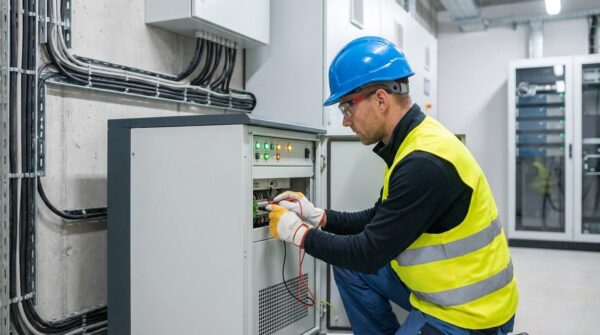


Modern commercial buildings increasingly rely on converged networks in which both data and electrical power travel over a single Ethernet cable. Integrating power and data allows facility managers to streamline infrastructure by using low-voltage lines to power devices that once required dedicated electrical outlets. While standard Power over Ethernet typically uses 48V, many specialized industrial and commercial devices operate on 24V passive PoE or direct current.
Choosing the right cabling for these applications requires a deep understanding of electrical capacity and signal integrity. Factors such as wire gauge, distance, and heat dissipation play a significant role in the system's reliability.
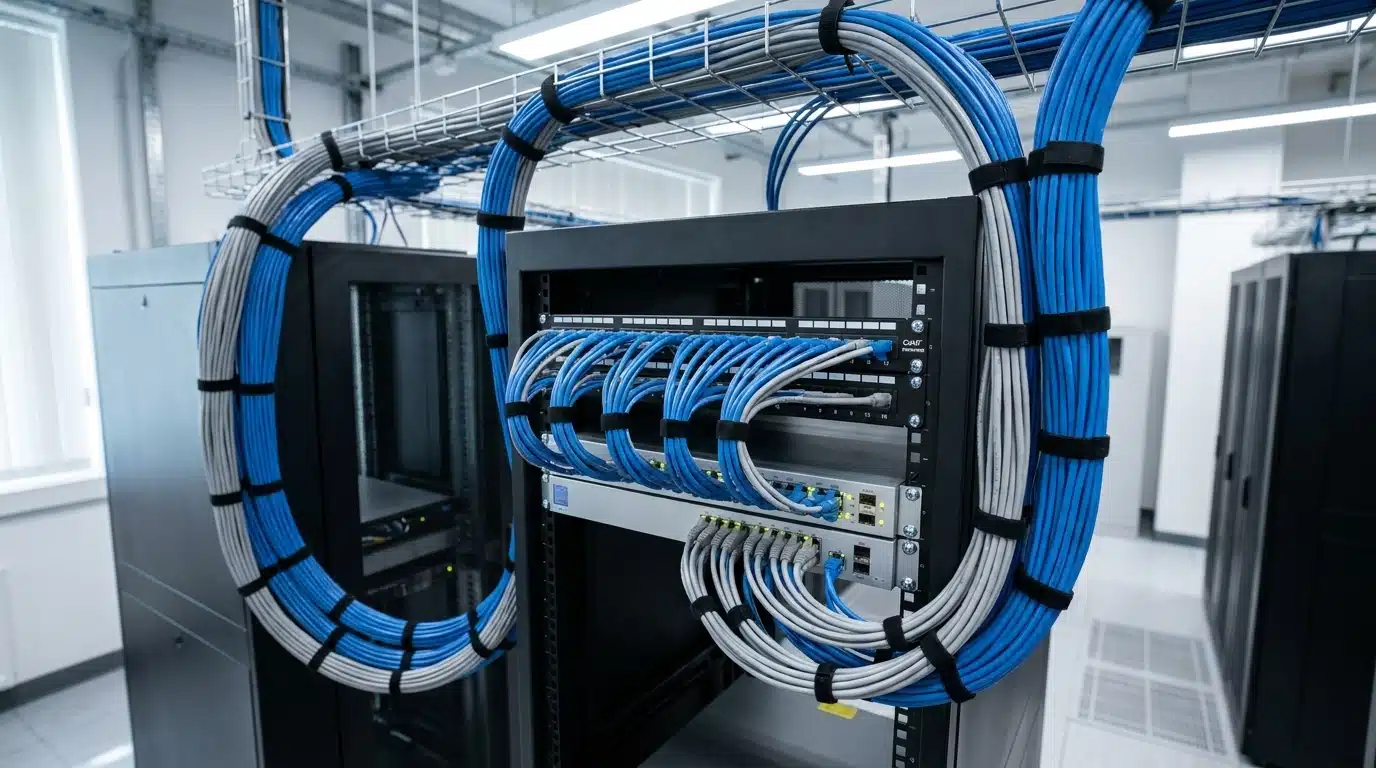
The Fundamentals of Low-Voltage Power Transmission Over Ethernet Cabling
Cat6 cabling supports 24V passive PoE through its internal copper pairs. While Cat6 was originally designed purely for high-speed data transfer, its construction is perfectly capable of transmitting low-voltage electricity. The twisted-pair design helps minimize interference while the copper conductors provide a pathway for electrical current to reach remote devices.
Understanding the wire gauge, the type of power delivery, and device requirements is crucial before designing a system. If these variables aren’t properly calculated, the system may suffer from performance issues or hardware failure. Engineers must evaluate the cable’s physical properties to ensure it can handle the intended electrical load over the required distance.
Understanding Cat6 Copper Infrastructure: 23 AWG vs. 24 AWG
Cat6 cabling typically uses 23 AWG or 24 AWG solid copper conductors, which are slightly thicker than those in older Cat5e cabling. The American Wire Gauge (AWG) standard dictates that a lower gauge number equates to a thicker wire diameter. For instance, a 24 AWG Ethernet conductor has a diameter of approximately 0.0201 inches (0.511 mm), making it more capable than 26- or 28-AWG options. Thicker Ethernet conductors allow electrical signals to travel with less resistance, maintaining signal integrity over longer distances.
The thickness of the copper directly affects its electrical resistance, a major factor in power delivery. Thicker conductors, such as 23 AWG, offer lower resistance and therefore better current-carrying capacity over long distances. The lowered resistance ensures that electrical signals travel with greater integrity while carrying more current in PoE applications, without excessive overheating. Professional installers often prefer 23 AWG copper data cabling for high-demand environments.
Using pure solid copper rather than copper-clad aluminum is mandatory for safe and efficient low-voltage power transmission. Solid copper provides the consistent conductivity required for high-power PoE applications, including standards such as IEEE 802.3bt, which support up to 90 W. Choosing inferior materials can lead to unpredictable voltage drops and increased fire risks in commercial environments. Solid copper conductors mitigate electrical resistance and ensure the system remains stable under full load.
Most permanent Cat5e and Cat6 installations use 24 AWG solid copper for optimal performance, though specialty infrastructure may use 23 AWG for enhanced performance. These cables are capable of reliable transmission over the full 100-meter channel distance specified in the ANSI/TIA-568 commercial building telecommunications cabling standards. Adhering to these benchmarks is a necessary part of low-voltage wiring in a professional context.
Power Over Ethernet (PoE) Standards Vs. Passive 24V Power
Standard active PoE operates at around 48-56 volts and uses a handshake protocol to negotiate power delivery with the end device. This protocol ensures that the power source sends power only to compatible devices, protecting non-PoE equipment from damage. After the handshake is complete, the system steps the voltage down to meet the endpoint’s specific needs. The larger conductor size of 24 AWG wire provides better heat handling for standards like IEEE 802.3at, which provides up to 30 W.
Passive 24V power contrasts with this by sending a continuous 24 volts down the spare pairs of the Cat6 cable without any active negotiation. It doesn’t check for device compatibility or adjust the output based on real-time needs. This simplicity makes it a cost-effective choice for specific hardware, but it requires the installer to verify compatibility manually to avoid hardware damage. Misidentifying these systems is one of the primary limitations of PoE in mixed-device networks.
The lack of active negotiation affects system design because passive 24V setups don’t compensate for power loss along the cable run. In an active system, the higher starting voltage and intelligent management help maintain stability over greater lengths. A passive system is much more sensitive to the cable’s physical limitations, meaning that every foot of distance can affect the final voltage delivered. Accurate calculations for low-voltage power transmission are vital because 24V systems have a much lower error threshold than standard 120V circuits.
Mid-Span Injectors Vs. End-Span Switches for 24V Distribution
When designing a 24V passive PoE infrastructure, engineers must choose between end-span switches and mid-span injectors. End-span distribution uses a network switch with built-in PoE, providing both data and 24V power directly from the switch ports. This method simplifies rack cable management and consolidates network equipment into a single appliance, making it ideal for new installations where converged switching is planned from the beginning.
Conversely, mid-span injectors are standalone devices placed between a standard non-PoE switch and the endpoint hardware. These injectors add 24V power to the Ethernet cable without interrupting the high-speed data payload from the upstream switch. Mid-span solutions are highly cost-effective for retrofitting existing networks, as they eliminate the need to replace expensive legacy IT switches while still providing reliable low-voltage power to remote devices.
How to Calculate Voltage Drop for 24V Cat6 Runs
Accurately predicting performance requires applying Ohm’s Law, where voltage equals current multiplied by resistance. For a 24V system, you must know the resistance of the 23 AWG or 24 AWG copper per 1,000 feet. Higher resistance leads to a larger voltage drop, which can starve the end device of the power it needs to operate. If the resistance of a 100-foot run is too high, the device may only receive 21V instead of the required 24V.
Engineers calculate the resistance based on the cable’s total loop length. Since the current must travel to the device and back, the resistance is effectively doubled for a single cable run. Using thicker 23 AWG conductors helps reduce this resistance, allowing for longer runs without exceeding the maximum acceptable voltage drop. These calculations are necessary to ensure that an Ethernet cable remains a reliable means of power delivery.
A standard 24 AWG copper wire has a specific resistance that must be accounted for in every design. If a device draws a high current, the voltage drop will increase linearly with the current according to Ohm’s Law. Designers should always aim for a drop of less than 10% to maintain reliable device operation. Pushing beyond this limit can cause electronic components to fail or reboot unexpectedly during peak usage.
How Device Power Requirements Dictate Cabling Capabilities
The specific power requirements of an endpoint device determine whether a 24V Cat6 run will succeed. It’s necessary to calculate the total wattage and amperage the device draws to ensure it stays within the cable’s safe operating limits. If a device pulls more current than the copper pairs can safely handle, the cable will generate excessive heat. Professional commercial cabling contractor services include these specific load audits.
If a device requires exactly 24V to operate, sending 24V from the source will likely cause it to fail. The copper’s resistance causes the voltage to drop below the necessary threshold by the time it reaches the device. This voltage sag can cause equipment to reboot constantly or fail to initialize its most power-hungry features. Maintaining a stable power supply requires a source slightly above the device’s minimum input voltage.
Evaluating Cat6 24V Capacity And Performance Capabilities
When the correct parameters are met, Cat6 is a highly efficient medium for powering commercial hardware. It provides a balanced solution that supports high-speed data while delivering enough current for most low-voltage applications. The robustness of Cat6 makes it the preferred choice for new commercial installations where power and data convergence is expected.
Evaluating the physical current limits, common applications, and economic benefits enables more strategic deployment of network resources. Proper evaluation prevents the need for expensive infrastructure changes after the initial installation is complete.
Current Carrying Limits for Standard RJ45 and Cat6 Conductors
The copper inside a Cat6 cable can handle a moderate amount of current, but the physical bottleneck is often the RJ45 connector. These connectors are generally rated at lower amperages than the cable itself. Typical maximum current ratings for 24 AWG conductors range from 0.577 to 3.5 A, depending on the bundle size and ambient temperature. However, for bundled Cat6, the current per conductor should typically stay below 0.6 A to comply with safety standards.
Sending more than a single amp per pair can cause localized heating at the contact points within the connector. This heat can degrade the plastic housing, leading to intermittent connectivity or complete port failure. Over time, high current draw through standard connectors can permanently damage the networking equipment. Melted contacts are a common failure point in complex network operations center environments.
Keeping the current draw well under the maximum rating is essential to prevent melting, electrical fires, or degradation of the data signal. It’s safer to use multiple pairs for power delivery when possible to distribute the electrical load. Engineers should always factor in a safety margin when determining the maximum amperage for a specific run. This safety margin protects the infrastructure from unexpected spikes in power demand.
Real-World Commercial Applications Powered By 24V Cat6
Cameras, access points, and sensors have varying minimum operating voltage thresholds. Some devices are designed with a wide input range, while others require a very specific voltage to function correctly. Reviewing the manufacturer specifications for every network device before finalizing the layout prevents intermittent connectivity issues caused by unmatched capacity.
Several types of commercial equipment commonly utilize 24V over Cat6 to simplify installation. Commercial access control systems, including electronic locks and badge readers, often rely on this power configuration. Motorized IP security cameras also use 24V passive PoE to drive their pan-tilt-zoom functions while transmitting high-definition video. These systems are common in facilities such as airports and casinos, where security is a high priority.
Industrial automation sensors and specific VoIP communication devices are also frequent endpoints for this technology. These devices are often located in areas where installing a traditional 120V outlet is difficult or prohibitively expensive. Using a single data cable for both functions allows for more flexible placement of critical hardware. Centralizing the power source simplifies the maintenance of surveillance cameras and industrial controls.
24V passive PoE is often preferred in these niche scenarios because of its simplicity and cost-effectiveness. It’s an ideal solution for powering remote IoT devices across expansive facilities like warehouses and manufacturing plants. By centralizing the power source, maintenance teams can more easily manage and reset devices from a single location. Centralizing power management is a major benefit for large-scale operations.
The Cost and Labor Efficiency of Utilizing Existing Data Lines
Facility managers and commercial electrical contractors can save significant labor and material costs by avoiding the need for separate high-voltage lines. Installing standard electrical conduits and outlets near every remote device adds complexity to any project. Using Cat6 for power eliminates the need for a licensed electrician to run 120V circuits to every camera or sensor location. Professional low-voltage wiring teams can deploy these systems more rapidly.
Leveraging existing low-voltage IT infrastructure allows for rapid deployment and easier scalability. When a business needs to add new devices to the network, it can do so without major structural modifications. This flexibility is a major advantage for growing companies that need to adapt their facilities to changing technology requirements. Because these devices are compatible with 24V Cat6, the resulting labor savings become a primary driver for adoption.
PoE is often chosen for outdoor or remote locations because it is safer than standard electrical cabling. It reduces the risk of electrical shock and simplifies the grounding requirements for remote hardware. This safety factor makes it a preferred choice for companies looking to minimize liability while expanding their network coverage. Saving on separate electrical lines allows businesses to allocate their budget toward higher-quality hardware.
Core PoE Limitations And Constraints For 24V Systems
Running 24V over copper Ethernet cable has strict physical and electrical limitations despite its convenience. It doesn’t offer the same plug-and-play simplicity as high-voltage systems in every scenario. Designers must be aware that the laws of physics impose hard caps on how this power can be utilized. Understanding specific PoE limitations is essential for facility managers in Tampa who are integrating smart building technologies into existing warehouse structures.
Voltage drop, distance constraints, and heat generation are the three primary factors engineers must account for. These factors are interconnected, meaning a change in one will likely impact the others. Ignoring these constraints can lead to a system that functions during testing but fails under full load. Proper planning requires a deep understanding of the 24 AWG wire specifications used in the project.
The Physics Of Voltage Drop in Low-Voltage Power Transmission
Ohm’s Law explains how the electrical resistance of the copper wire consumes a portion of the voltage as heat. As current travels over long distances, the resistance of 23 AWG or 24 AWG wire slowly dissipates energy. For a 24 VDC system, a 10% voltage drop is generally considered the maximum acceptable limit for reliable operation. If a run is too long, the voltage drop will prevent the device from initializing correctly.
Because the starting voltage is only 24V, even a drop of three or four volts represents a massive percentage of the total power. A device expecting 24V might refuse to turn on if it only receives 20V due to cable resistance. The amplified effect of voltage loss is why 24 VDC PLC systems and other low-voltage hardware are particularly sensitive to cable run length. Small absolute drops represent a large percentage of the supply voltage in these systems.
The load current also plays a major role in the voltage loss over the run. At a 100 mA load using 24 AWG copper, the maximum recommended distance for a 12V system is 216 feet to stay within a 10% drop. If that load increases to 1,000 mA, the safe distance for that same wire drops significantly to only 21 feet. High-amperage devices require much shorter cable runs to maintain stable voltage.
In standard 120V or 48V PoE systems, a drop in voltage of the same magnitude would have a negligible impact on the device’s operation. A three-volt drop from a 120V source is less than 3%, which most electronics can handle easily. However, in a 24V system, that same three-volt loss is a 12.5% reduction, which often exceeds the device’s tolerance. This makes the distance calculation a critical part of the initial design phase.
How Far Can You Safely Run 24V Over Cat6?
The standard data transmission limit for Ethernet is roughly 328 feet (100 meters), but 24V passive PoE will fail much sooner. Data packets can travel the full length of the cable with little trouble, but electrical current cannot. You’ll often find that the network connection is “up” while the device itself remains powered off. This discrepancy can be confusing during the troubleshooting phase of an installation.
Technical guidelines suggest that 24V passive PoE runs should generally be kept under 150 feet (approximately 50 meters). For a 24V DC load of about 833 mA over 24 AWG copper, the recommended maximum distance is only 52 feet to maintain stability. If the device has a tighter 5% tolerance, this distance is effectively halved. Distance varies with the device’s current draw and the wire gauge.
Pushing beyond this PoE limitation without a step-up converter or mid-span injector will result in unreliable equipment performance. If your device is located 200 feet away, a 24V supply at the source is likely insufficient. In these cases, you must either use a higher starting voltage or place the power source closer to the endpoint. Long-distance runs usually require a 48V supply to ensure enough power reaches the far end.
The 100-meter figure used in cabling standards is primarily a standards-and-test-equipment limit rather than an absolute limit for power transmission. High-quality 23- or 24-AWG copper cable can physically transmit power over distances longer than 100 meters if the voltage drop is managed. However, staying within the standard limits is the only way to ensure the system passes professional certification. Long runs should be carefully monitored for potential power fluctuations.
Overheating Risks And Cable Bundle Heat Dissipation
Electrical current traveling through the thin 23 AWG or 24 AWG conductors naturally generates heat as a byproduct of resistance. While a single cable might stay cool, the cumulative effect in a bundle can be dangerous. This issue is exacerbated when dozens of powered Cat6 cables are tightly bundled together on cable trays. Understanding how to prevent Cat6 cable overheating in bundles is a key safety requirement for all installers.
The wires at the center of a dense bundle cannot effectively dissipate heat to the ambient air. This trapped heat can reach temperatures that exceed the cable’s insulation rating. Excessive heat not only creates a fire hazard but also increases the electrical resistance of copper, further worsening the voltage drop. Proper airflow must be maintained to prevent the infrastructure from reaching dangerous temperatures.
Ambient temperature in Florida warehouses can increase copper resistance, further shortening the effective range of 24V power. High temperatures in these environments can cause the voltage drop to exceed the 10% limit much sooner than in a climate-controlled office. It’s important to follow industry standards for bundle sizes to ensure proper airflow and cooling. Using thicker 23 AWG conductors can help mitigate some of these thermal issues by providing a larger surface area.
Navigating Electrical Code And Compliance for Low-Voltage Networks
Even though 24V is considered low voltage and generally safer than standard mains power, it’s still subject to strict building codes. Poorly installed low-voltage lines can still violate fire and life-safety codes. It’s a common misconception that low-voltage work doesn’t require the same level of scrutiny as high-voltage electrical work. Installers must still comply with all local and national requirements to ensure a safe environment.
National Electrical Code (NEC) guidelines, established by the National Fire Protection Association (NFPA), must be followed by commercial electrical contractors when installing powered data lines. These rules are in place to ensure that the cabling doesn’t become a source of ignition or a pathway for fire. Compliance is necessary to pass inspections and maintain insurance coverage for a commercial property. Working with a professional ensures that your system meets all relevant Class 2 circuit requirements for commercial low-voltage installations.
NEC Article 725 and Class 2 Circuit Classifications
Installations involving 24V over Ethernet generally fall under NEC Article 725 as Class 2 power-limited circuits. These circuits are deemed safe with respect to fire initiation and electric shock under normal operating conditions. The classification is based on the power source’s ability to limit the amount of energy it can deliver to a fault. 24 V DC control and signal wiring is typically classified as Class 2 or Class 3 power-limited circuits.
Class 2 circuits have specific power and amperage ceilings that must be strictly maintained. For example, the power supply must be listed and labeled as a Class 2 source to meet these regulatory definitions. These limitations allow the use of smaller wire gauges and different installation methods compared to standard power circuits. Professionals must verify that every component in the system adheres to these specific energy limits.
Working with a professional commercial electrical contractor ensures that all power supplies, injectors, and cabling meet these strict definitions. They can verify that the power source is correctly matched to the cable’s capacity and the device’s load. This professional oversight prevents code violations that could lead to costly fines or safety hazards. Proper documentation of these systems is also required for final building certifications.
Rules For Running 24V Power And Data In The Same Conduit
Because 24V DC is considered extra-low voltage, it’s generally permissible to run it alongside Ethernet data cables within the same conduit. Sharing a conduit is allowed because both are classified as power-limited signals that don’t pose a significant risk to one another. Under typical industrial conditions with 24 V DC power in the 10-20 A range, this approach is generally acceptable if precautions are followed.
However, installers must remain cautious about potential electromagnetic interference if the 24V power source utilizes rapid switching. If the power line is driving inductive loads, such as heavy motors, it could create noise that disrupts the data signal on the Ethernet pairs. Proper separation or shielding should be used if the power and data are not part of the same PoE system. Maintaining signal integrity is the primary goal when sharing pathways.
NEC separation rules for high-voltage power still apply, meaning you cannot run these low-voltage lines in the same conduit as 120V or 277V circuits. Mixing high and low voltage in the same pathway is a major code violation and a serious safety risk. Always ensure that the low-voltage infrastructure is physically isolated from the building’s main electrical distribution. Isolating the high and low-voltage pathways is a fundamental requirement of the National Electrical Code for safety.
Safety Thresholds For Commercial Ethernet Cable Infrastructure
The safety of a low-voltage installation also depends on the specific jacket ratings required for commercial environments. There are major differences between riser-rated and plenum-rated Cat6 cables that must be understood. Spaces with environmental air circulation, such as the area above a drop ceiling, require plenum-rated jackets to prevent the emission of toxic smoke.
Plenum-rated cables use materials that resist burning and emit less toxic smoke if a fire does occur. Using the wrong cable type in these spaces violates fire codes and can put building occupants at risk. Using cables with the correct temperature and fire-resistance ratings is non-negotiable when sending continuous electrical current through them. These ratings ensure the building stays safe even during an electrical fault.
The cable’s temperature rating is also critical when power is delivered over the Ethernet pairs. Continuous current generates heat, and the cable must be rated to handle that temperature rise without the insulation breaking down. High-quality Cat6 cables often have higher temperature ratings to accommodate the demands of modern PoE technology. Installers should always check the cable jacket for the specific temperature and fire ratings before beginning the pull.
Designing And Mitigating Interference In 24V Cat6 Systems
Carrying direct current over the same cable that handles high-speed data transfer requires careful design. The goal is to prevent the power delivery from degrading the network performance or causing packet loss. If the system isn’t balanced correctly, the electrical noise can make the data connection unstable. Professional design ensures the network remains reliable even under high power loads.
Designing a robust system involves choosing the right cable type and ensuring the installation environment is managed. Engineers must account for external noise sources and internal crosstalk between the twisted pairs. Taking these precautions ensures that the network remains fast and reliable even under full power. Proper shielding and grounding are the primary tools for achieving this stability.
Dealing With Electromagnetic Interference (EMI) And Crosstalk
Fluctuations in power draw can theoretically generate magnetic fields that interfere with data packets traveling over adjacent pairs. This is particularly true if the 24V devices have variable power needs that cause the current to spike or dip. However, Cat6 is designed with tight twists and internal splines specifically to combat this type of internal crosstalk. These physical features ensure the data signal remains clear.
The physical construction of Cat6 makes it highly resilient to interference from the power it’s carrying. The internal separator, or spline, keeps the pairs at a consistent distance from each other to minimize magnetic coupling. This design allows the cable to maintain high-speed data transmission even when all four pairs are being used for power. It provides a level of data integrity that older standards cannot match.
Best practices for grounding and cable separation should be followed when 24V lines run near heavy industrial equipment. Industrial environments often have high levels of ambient electromagnetic noise from large motors and transformers. In these cases, the installation team must take extra steps to protect the low-voltage signals from external degradation. Shielded cabling is often a necessity in these challenging environments.
When To Choose Shielded (STP) Over Unshielded (UTP) Cat6
Unshielded UTP Cat6 is sufficient for most standard office environments where electromagnetic noise is relatively low. It’s easier to install and more flexible than shielded options, making it the standard for most commercial buildings. However, certain environments demand the extra protection that shielded cabling provides. Choosing the right cable type is a key part of the initial network design process.
Shielded STP Cat6, which utilizes either a foil shield around the entire cable (F/UTP) or individual foil shields around each twisted pair (U/FTP), is highly recommended for industrial properties, warehouses, and manufacturing facilities. The foil shielding serves as a barrier, protecting low-voltage power and data signals from external electrical noise. This is especially important when the cable runs are long and pass near high-voltage machinery. Shielding prevents data errors and power fluctuations caused by external magnetic fields.
The entire system must be properly grounded at the patch panel or switch for the shielding to be effective. If the shield isn’t grounded, it can act as an antenna, attracting more interference and worsening the problem. Professional installers have the tools to verify that the grounding path is continuous and effective for the entire network. Proper grounding is a non-negotiable step for any shielded installation.
Alternatives And Extensions For Long-Range PoE Limitations
When a run exceeds the capabilities of 24V over Cat6, several solutions are available to maintain performance. One common approach is using active 48V PoE switches paired with remote step-down converters at the device end. This allows you to leverage the better distance capabilities of 48V while providing the 24V the device requires. This hybrid approach solves most distance-related power issues.
PoE extenders and mid-span injectors can also be used to boost the signal and power along the way. PoE extenders can extend the reach to about 4,100 feet from the source, which is more than 12 times that of a single 100-meter run. However, each added termination point introduces additional insertion loss and noise that can eventually render the cable inoperable. These devices should be used strategically to maintain system reliability.
Transitioning to fiber optic cabling with localized power sources is another option for extremely long runs. Fiber doesn’t have the distance limitations of copper, but it cannot carry electrical current. In these scenarios, power is supplied at the remote end via a local power supply or a specialized hybrid fiber cable. This is often the best solution for large campuses or outdoor installations.
New EOC technology can transmit PoE power and data over up to 1,000 meters via standard Cat5e or Cat6 cabling. These systems often use a hybrid switch that auto-detects the load device and transmits power accordingly. This is a highly specialized solution for scenarios like powering a remote security camera 500 meters away between buildings. These advanced tools provide a way to overcome the limitations of traditional copper cabling physics.
Future-Proofing Commercial Facilities With Scalable Infrastructure
As smart buildings become more advanced, the demand for reliable power and data delivery will only increase. Most new commercial hardware is being designed to take advantage of low-voltage transmission to reduce installation costs. Planning for these needs today prevents the need for expensive infrastructural overhauls in the future. Investing in a high-quality backbone is a smart long-term strategy for any property owner.
Proper planning involves installing the highest quality cabling possible to accommodate future technology upgrades. Even if your current devices only require a small amount of power, the next generation of hardware may have higher demands. Investing in a robust Cat6 backbone ensures that your facility is ready for whatever comes next. This proactive approach saves money and reduces future operational downtime.
Adapting To Advanced Smart Building And IoT Technologies
Modern infrastructure is shifting toward heavy reliance on IoT devices, automated HVAC controls, and intelligent LED lighting systems. PoE now powers at least a third of IoT devices, including digital signage and monitoring sensors in industrial environments. These systems thrive on the efficiency and centralized control offered by low-voltage power transmission. They are the foundation of the modern “smart” facility.
Installing high-quality, solid-copper Cat6 today guarantees the facility has the backbone required to support these technologies. Solid copper conductors handle the heat of continuous power delivery much better than cheaper alternatives. This durability is essential for systems that are expected to run 24/7 for many years. Choosing the right materials today prevents expensive repairs in the future.
Smart commercial hardware is becoming increasingly integrated into the building’s overall management system. This integration requires a reliable network capable of handling both the data traffic and the electrical load of hundreds of devices. A well-designed Cat6 infrastructure provides the scalability needed to add new features without replacing the existing wiring. It allows your building to evolve as technology advances.
Maintenance And Testing Protocols For Powered Data Lines
Ongoing maintenance is required for powered Ethernet systems to ensure they continue to operate safely and efficiently. Specialized testing equipment is needed to measure not just data continuity, but also the actual voltage and wattage being delivered. Standard cable testers often miss issues related to voltage drop and power delivery. Professional maintenance includes these advanced diagnostic checks.
Commercial facilities should implement routine diagnostic checks to ensure there is no hidden degradation in the cable bundles. Heat can slowly damage the insulation of the wires, leading to shorts or increased resistance over time. Checking the temperature of high-density bundles with infrared cameras can help identify potential hotspots before they become a problem. These proactive measures prevent fire hazards and system failures.
It’s also important to inspect RJ45 contacts for signs of arcing or localized heating. If a device is pulling too much current, the contacts may show signs of discoloration or melting. Regular inspections ensure the longevity and reliability of the electrical infrastructure while protecting the building from fire risks. In commercial environments, 24V passive PoE lines should be clearly labeled at both ends to prevent accidents. Proper labeling ensures IT staff don’t accidentally plug incompatible devices into a live port.
Troubleshooting Low-Voltage Power Issues
When a device fails to power on, the first step is to use a digital multimeter to check for a voltage sag at the terminal block. Measuring the voltage under load provides the most accurate picture of the system’s performance. If the voltage is significantly lower than the source, the cable run is likely too long, or the wire gauge is too thin. This technical data is necessary for identifying the root cause of power issues.
Thermal imaging cameras can also be used in server rooms to identify heat buildup from resistance in dense cable bundles. High temperatures in a bundle often indicate that the current draw exceeds the safe limits for the wire gauge. Identifying these hotspots allows the maintenance team to redistribute the power load before permanent damage occurs. These advanced tools are a necessary part of any professional maintenance program.
Checking for physical damage to the cable jacket is another essential troubleshooting step. In industrial environments, cables are often exposed to physical stress that can damage the internal conductors. A small break in the wire can increase resistance and cause significant voltage fluctuations. Regular physical inspections help maintain the long-term health of the network infrastructure.
Optimize Your Facility With Professional Low-Voltage Design
Carrying 24V power over Cat6 cabling is an effective way to streamline commercial infrastructure, but success depends on managing strict physical and electrical limits. Designers must balance the convenience of low-voltage power with the challenges of voltage drop, distance, and heat dissipation.
Designing and installing these complex systems requires expert knowledge to ensure long-term reliability and code compliance. Suncoast Power has more than 40 years of experience delivering high-quality, dependable commercial electrical services across Florida. We specialize in designing and installing robust infrastructure that keeps your business powered reliably while meeting all safety standards. Our expertise ensures your facility remains safe and efficient as your technology needs grow.
Our team of skilled professionals is ready to help you navigate the complexities of 24V power transmission and Cat6 integration. Contact our team today to discuss your project and discover how our expertise can benefit your property.