





High-quality lighting systems are fundamental to the success of modern commercial and industrial facilities. These systems do more than illuminate a workspace, as they directly influence worker productivity and employee safety. Optimizing your lighting infrastructure can also lead to significant improvements in energy efficiency and long-term operational savings.
Properly forecasting a lighting upgrade budget requires a deep understanding of how professionals value their work. Business owners must account for electrical contractor pricing models and the specific variables that drive labor estimation. Understanding the mechanics of these systems is the first step toward accurately forecasting the return on your commercial lighting investment.
The Importance of a Comprehensive Lighting Audit
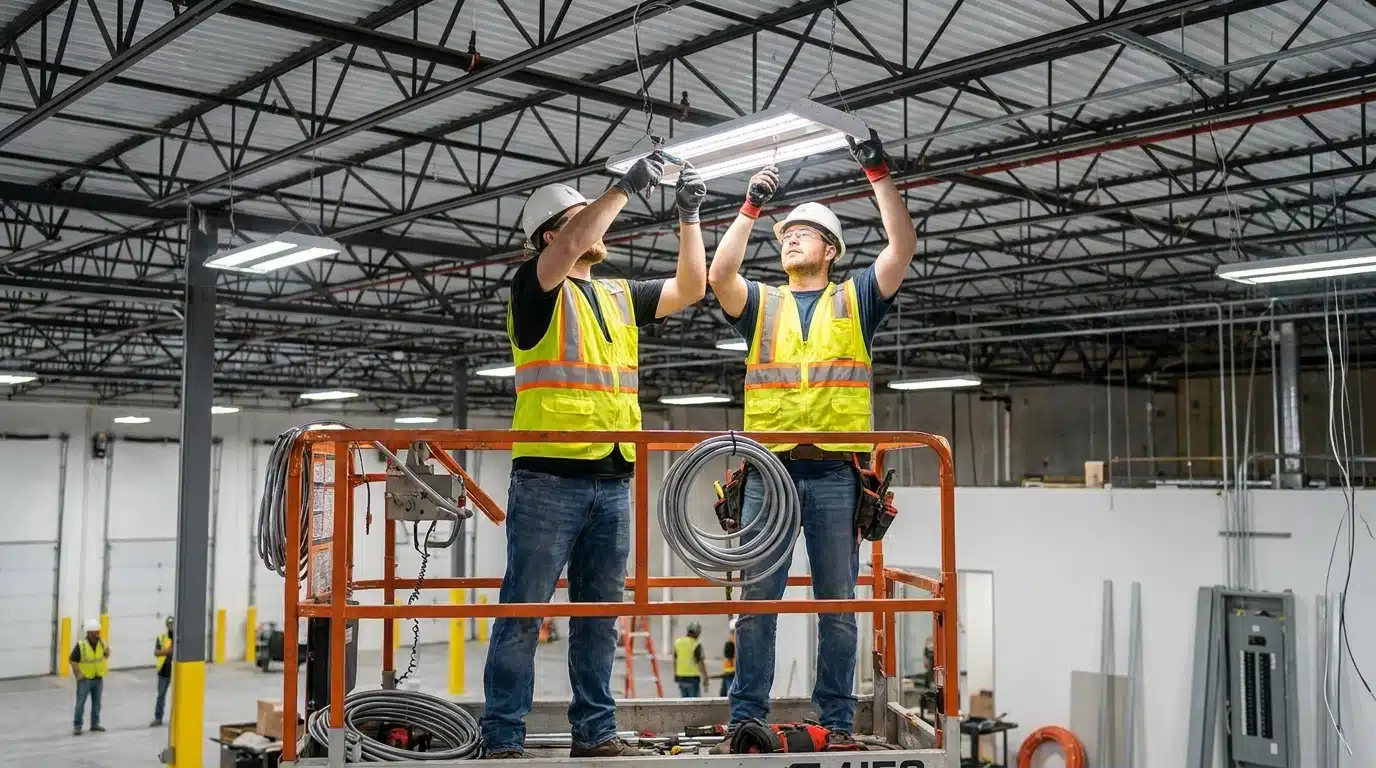
A commercial lighting audit is the first step before generating a final price quote for a large facility. During an audit, an electrical contractor visits the site to assess current energy usage and measure existing light levels. Conducting a hands-on evaluation allows the team to identify the exact number of fixtures and the type of wiring needed.
The audit also evaluates the condition of the existing electrical infrastructure to see if upgrades are required. Taking a proactive approach helps identify potential issues that might lead to change orders later in the process. It ensures that the proposed lighting solution provides the correct amount of illumination for the specific tasks performed in that space.
A detailed audit provides the data needed to calculate accurate energy savings and project payback periods. You can learn more about how these evaluations are conducted by reviewing our guide on lighting audits for commercial spaces. Audit data is essential for justifying the investment to stakeholders and financial officers.
Professional contractors use these audits to establish a baseline for future labor and material costs. They identify where sensors or dimmers can maximize energy reductions in high-traffic areas. Identifying these opportunities early prevents expensive adjustments during the physical installation phase.
How Do Electrical Contractors Estimate Lighting Installation Labor Costs?
Estimating labor for a commercial project is a systematic process that involves more than just a simple guess at the number of hours. Experienced electricians use a structured approach to ensure the quote covers all necessary tasks while remaining competitive. The estimating process requires a thorough evaluation of the technical requirements and the specific site conditions that might slow down progress.
A comprehensive estimate accounts for labor hours, material requirements, local permits, and the contractor’s overhead. Professionals also account for a reasonable profit margin to ensure the long-term sustainability of their business. Understanding these components helps you see why commercial electrician rates are structured the way they are.
Licensed electricians perform lighting installations to satisfy municipal building codes. These codes ensure that every connection is safe and durable enough for industrial environments. Following these standards prevents the risk of electrical fires or premature system failures.
Average Hourly Rates and Prevailing Wage Factors
Typical hourly rates for skilled commercial electricians range from $75 to $150. The exact rate varies based on the project’s location and the technical complexity of the work. Highly specialized tasks or hazardous environments often command rates at the higher end of this spectrum.
There’s a significant difference between standard non-union labor rates and union labor rates. Publicly funded or government projects often require prevailing wage rates, which are mandated by law to ensure fair compensation. These rates are typically higher than private sector averages and include specific requirements for health and welfare benefits.
A fully burdened labor rate includes more than just the hourly pay the electrician receives. Contractors must factor in payroll taxes, workers’ compensation insurance, general liability insurance, and employee benefits. When you see a billing rate of $125 per hour, a large portion of that covers these mandatory business protections and overhead costs.
Contractors also include the cost of specialized training and certifications in their hourly rates. Ensuring that the crew is up to date on National Electrical Code (NEC) 2023 standards, OSHA safety protocols, and National Fire Protection Association (NFPA) guidelines requires a significant investment in continuous education. Mastering these interconnected regulatory frameworks ensures that your complex industrial lighting network is installed safely and passes all municipal inspections.
The Impact of Location and Regional Market Dynamics
Geographic location is a primary driver of variations in lighting installation labor costs across the country. In areas with a high cost of living, contractors must pay higher wages to attract and retain skilled tradespeople. Local economic conditions and the current supply of licensed electricians also influence how much you’ll pay for services.
The Tampa, FL market and the broader Florida region represent a rapidly growing commercial sector. Such rapid expansion creates a high demand for specialized infrastructure and scalable electrical solutions for new warehouses and shopping centers. Regional pricing reflects this competitive landscape, in which facility managers prioritize efficiency and reliability.
You should research local market averages to set a realistic baseline for your lighting upgrade budget. Comparing multiple quotes within the same region allows you to identify outliers and ensure you’re paying a fair price. Understanding regional dynamics prevents you from being caught off guard by price fluctuations driven by local market demand.
In competitive markets, contractors may offer volume-based pricing for larger installations. Volume pricing allows facility managers to reduce the per-fixture cost when upgrading an entire property. Large-scale projects provide the efficiency needed to lower the total labor burden per unit.
Interior vs. Exterior Lighting Installation Labor Cost
There’s a significant difference in labor requirements between interior fixture swaps and exterior lighting projects. Interior work often involves using ladders or small scissor lifts to reach ceiling heights of 10 to 15 feet. These projects move quickly and incur lower equipment rental costs than large-scale outdoor upgrades.
Exterior lighting projects often require trenching and underground wiring to connect pole lights. This work involves heavy machinery and specialized labor to ensure the conduits are buried at the correct depths. Maintaining the benefits of an LED parking lot depends on a stable and protected power source.
Working on high exterior poles requires bucket trucks or 60-foot articulating boom lifts. These machines carry higher daily rental fees and require operators with specific safety certifications. The increased risk of working at height and in unpredictable weather conditions drives up the labor rate for exterior tasks.
Installers must also account for the structural integrity of pole bases and foundations during exterior upgrades. If the pole base is corroded, the labor to repair or replace the concrete footing must be included in the estimate. These structural factors are a major variable in the final cost of outdoor lighting systems.
What Are the Standard Pricing Models Used for Commercial Lighting Projects?
Business owners must understand the different pricing models before committing to a formal contract. The specific model a contractor uses affects your budget predictability and the project’s flexibility. Choosing the wrong structure can lead to financial friction if the scope of the work changes unexpectedly during the installation.
The right pricing model depends on the nature of the work and the clarity of the project details. Some models offer a guaranteed price, while others provide transparency through detailed time tracking. Transitioning between these models requires a clear agreement between the facility owner and the electrical contractor.
Electrical contractor pricing is generally divided into three main categories. Each has its own benefits and risks for the client and the contractor. You’ll want to select the one that matches the predictability of your project’s scope.
Hourly Billing (Time and Materials)
Hourly billing, often called Time and Materials, is the standard approach for complex commercial work and troubleshooting. Hourly billing is ideal when the total scope of the project isn’t fully known at the start. Electricians bill for the actual hours spent on the job site, plus the cost of the materials used for the repair or installation.
The main advantage of hourly billing is the flexibility it provides when project requirements evolve mid-installation. It ensures fairness for both the client and the contractor during unpredictable repairs that may uncover hidden issues. If a repair takes less time than expected, the client only pays for the actual labor performed.
Some clients find the lack of a guaranteed maximum price to be a potential drawback of this model. To mitigate this risk, professional contractors use detailed time-tracking systems and provide transparent reporting to the client. Contractors often charge a minimum hourly rate for the first hour of work to cover travel time and initial setup costs.
An hourly model is most common for maintenance calls or when repairing storm damage to exterior fixtures. It allows the contractor to investigate the problem thoroughly without the pressure of a fixed bid. You only pay for the expertise and time needed to restore your system to full operation.
Fixed-Price Bids and Flat-Rate Pricing
Fixed-price or flat-rate bids provide a guaranteed total cost for the entire project upfront. The guaranteed price remains the same regardless of how many labor hours the contractor actually spends on the job. It’s a popular choice for businesses that need absolute certainty for their lighting upgrade budget.
The fixed-price model is highly recommended for projects with a predictable scope, such as standard lighting retrofits or LED high-bay installations. Routine tasks like electrical panel upgrades or installing a set number of troffers are also well-suited for flat rates. The contractor assumes the risk of labor overruns, which provides peace of mind to the facility manager.
Flat-rate pricing benefits the customer by eliminating the stress of watching the clock during installation. It allows for easier financial planning and simplifies the approval process for corporate accounting departments. You won’t have to worry about the invoice increasing if a particular task takes slightly longer than the electrician anticipated.
Contractors must have highly accurate estimating processes to offer fixed-price bids without losing money. They rely on historical data and site walks to calculate the most likely labor requirements. If the contractor underestimates the effort, they must absorb the additional labor costs themselves.
Unit Pricing and Per-Point Pricing Models
Unit pricing is a model where contractors charge a set fee per fixture installed or per electrical point wired. The per-point approach simplifies the quoting process for large facilities such as airports and large shopping centers. Instead of calculating total hours, the contractor multiplies the number of units by the agreed-upon unit price.
Unit pricing scales easily as the project size increases or decreases during the planning phase. If a project manager decides to add 50 more lights to a warehouse wing, they can quickly calculate the cost increase. It provides a clear and repeatable way to measure project progress and costs.
Project managers use per-point pricing to keep financial projections accurate across different phases of construction. It reduces the need for constant negotiation, as long as the fixture type remains the same. A per-point method is particularly effective for large-scale commercial developments with repetitive floor plans.
Using unit pricing helps in auditing the project at various stages of completion. You can easily verify that the number of fixtures billed matches the number of fixtures installed on the floor. It creates a transparent relationship between the contractor’s work and the final invoice.
Key Variables That Influence Commercial Lighting Labor Estimation
Physical realities in a commercial space strongly influence the final labor costs for any project. Unlike residential work, commercial environments present unique logistical challenges that require specialized skills and equipment. These factors can quickly turn a simple fixture swap into a complex technical operation.
Industrial and commercial properties often have architectural features that impede standard installation methods. High-voltage requirements and complex wiring networks also increase the time required for a safe installation. Understanding these variables is necessary for creating an accurate estimate for your facility.
LED retrofits reduce monthly utility expenses for commercial facilities. However, the labor required to achieve these savings depends on the complexity of the existing wiring. Understanding factors such as ceiling height, facility access, and specialized equipment requirements helps facility managers better anticipate total project costs.
Project Scope, Ceiling Height, and Facility Complexity
Replacing troffers in standard drop ceilings is a relatively quick task for an experienced crew. However, installing high-bay lighting in a manufacturing facility requires significantly more labor hours per fixture. The ceiling height and the density of existing infrastructure determine how quickly the team can work.
Specialized environments like clean rooms, casinos, or active retail floors introduce additional complexities. Electricians often must work around ongoing daily operations or sensitive equipment that cannot be moved. These constraints require more careful planning and slower execution to avoid disrupting the client’s business.
High ceilings directly increase labor costs due to the extra time required for safety. Maneuvering heavy equipment through tight aisles or around machinery requires more effort than on a standard floor. Labor estimates must account for the time spent ascending and descending lifts throughout the workday.
Electricians must also factor in the time needed to relocate office furniture or cover sensitive equipment. In data centers, work must be performed with extreme care to avoid accidental outages. These high-stakes environments demand a slower, more deliberate pace that is reflected in the final bid.
Technical Requirements for Specialized Lifts and Equipment
Commercial lighting projects frequently require specialized lifts to reach exterior parking lot poles or high interior ceilings. These pieces of equipment are essential for maintaining safety standards while working at significant heights. The rental and transportation costs for these machines are factored into the overall project estimate.
Operating bucket trucks, boom lifts, and scissor lifts requires specific training and adds to the labor burden. Contractors must ensure that their crew is certified to use this equipment in a variety of environments. The cost of fuel and maintenance for these machines is another factor that influences electrical contractor pricing.
We use 19-foot scissor lifts for interior warehouse aisles to ensure our team has a stable working platform. For exterior poles, a 60-foot articulating boom lift allows us to navigate around trees and landscaping. Using the right tool for the job ensures the installation is both safe and efficient.
An electrical contractor’s access to their own fleet of equipment can streamline the entire process. We maintain our own machinery to provide more cost-effective solutions for our clients. Contractors who must rent every piece of equipment often pass those higher rental fees directly to the facility owner.
Commercial Building Codes and OSHA Safety Compliance
Adhering to strict commercial building codes and National Electrical Code standards requires highly skilled labor. These regulations ensure that the installation is safe for occupants and durable enough for industrial use. Licensed electricians spend years learning these codes, and their expertise is reflected in their labor rates.
OSHA safety compliance is a non-negotiable aspect of any professional commercial job site. Mandatory safety protocols, such as lockout and tagout procedures, require additional time and oversight from a site supervisor. Using personal protective equipment and setting up safety barriers are necessary steps that impact the total labor hours.
Cutting corners on safety is never a valid option for a legitimate contractor. We factor strict compliance into our labor rates to protect both our crew and the client’s property. While these procedures might increase the initial cost, they prevent costly accidents and legal liabilities in the future.
Supervisors must conduct daily safety briefings and inspect all equipment before work begins. Allocating administrative time is essential for maintaining a zero-accident record on complex industrial sites. Professional contractors prioritize safety to ensure the long-term success of every lighting project.
After-Hours Work, Weekends, and Emergency Rates
Many commercial facilities cannot afford operational downtime during standard business hours. Retail centers, airports, and manufacturing plants often require lighting installations to be performed at night or on weekends. Off-hours scheduling ensures that the work does not interfere with customers or production cycles.
Off-hours scheduling typically incurs premium labor rates or overtime pay for the electrical crew. These premiums must be clearly outlined in the initial proposal to avoid surprises on the final invoice. Emergency call-outs at night or on weekends often incur an additional fee of $100 to $200 per visit.
Facility managers should weigh the cost of premium labor rates against the potential revenue lost during a shutdown. In many cases, paying for after-hours work is more economical than closing a high-traffic business for several days. Discussing your scheduling needs early helps the contractor provide a more accurate budget for the lighting upgrade.
Night shifts also present unique challenges for the electrical crew, such as limited access to supply houses. Contractors must stage all materials on-site before the shift begins to avoid delays. Meticulous logistics planning is critical to managing after-hours lighting projects effectively.
Material Markups, Permit Fees, and Project Overhead
Labor is only one part of the equation when you are calculating the total cost of a lighting installation. Contractors must also account for the materials they supply and the legal permissions required for the work. Managing these costs effectively is part of what makes a commercial electrical project successful.
A legitimate contracting business also has operational overhead that its project fees must cover. This includes the cost of office staff, vehicle maintenance, and specialized tools used across many projects. These non-labor costs are essential for maintaining a high standard of service and reliability.
The total cost of your project reflects the infrastructure needed to support a professional team. From insurance to specialized software, these items ensure your project is managed with precision. Factoring in elements like supply chain logistics, municipal compliance, and specialized installation tools ensures a transparent and highly accurate project quote.
Understanding Standard Material Markups and BOM Management
It is standard practice for electrical contractors to apply a markup to materials such as LED fixtures and conduit. A material markup covers the time spent sourcing, ordering, and storing the components before they arrive on site. It also accounts for the logistics of transporting materials to the facility and managing the warranty process.
Effective Bill of Materials (BOM) management is essential for large projects, such as a 500-fixture warehouse upgrade. Contractors must stage materials in waves to prevent site clutter and protect against potential theft. Managing this inventory requires dedicated labor to ensure the right parts are available exactly when the crew needs them.
Paying a material markup is often more cost-effective than buying fixtures independently. Contractors have access to commercial-grade products that are not available at standard retail stores. They also use wholesale supply networks to secure better pricing on bulk hardware orders.
When a contractor provides the materials, they also take responsibility for any defects or shipping damages. If a fixture arrives damaged, the contractor handles the return and replacement at no extra labor charge. Warranty management provides a layer of protection that you wouldn’t have if you sourced the materials yourself.
Navigating Permit Fees and Local Inspections
Significant lighting upgrades and commercial electrical work require permits from the local municipality. These permits come with filing fees ranging from $75 to $ 150, depending on the scope of the project. Contractors pass these costs through to the client as part of the total project price.
The contractor is responsible for handling all permit applications and coordinating with city inspectors. Ensuring the work passes code compliance the first time is a critical part of their professional service. A safety inspection can cost between $100 and $125 and is a necessary step for verifying the quality of the installation.
Professional contractors include these permit and inspection fees transparently in their proposals. Upfront transparency ensures there are no hidden surprises or legal issues for the facility owner once the work is complete. Accurate documentation of permits is also important for insurance purposes and future property valuations.
In some jurisdictions, complex exterior projects may require additional structural or environmental permits. These documents ensure that the new lighting doesn’t create light pollution or interfere with local wildlife. Handling this paperwork is a value-added service that experienced contractors provide to their clients.
Environmental Compliance and Legacy Fixture Disposal
Upgrading a commercial facility inevitably generates hazardous waste that requires specialized handling and legal documentation. Older fluorescent tubes contain mercury, and legacy magnetic ballasts may contain polychlorinated biphenyls (PCBs). Licensed electrical contractors must strictly follow Environmental Protection Agency guidelines when removing and transporting these hazardous materials.
The labor required to carefully extract these components without breaking them adds to the overall project estimate. Contractors must package the waste in approved containers and transport it to certified recycling facilities. A comprehensive commercial lighting quote will always include the specialized labor and recycling fees required to keep your facility compliant with federal environmental regulations.
Preventive Maintenance Contracts for Commercial Systems
Many commercial clients look for long-term support to protect their investment in new lighting infrastructure. Preventive maintenance contracts help manage future repair costs through a predictable monthly or annual fee. These agreements often include priority scheduling for emergency repairs and routine inspections of all fixtures.
A typical maintenance model might involve a monthly retainer that covers lamp and ballast replacement or LED driver checks. For large facilities, this per-visit model ensures that burnt-out lights are replaced before they compromise safety. Regular fixture cleaning can also maintain optimal light levels and extend hardware lifespan.
Contractors use these visits to check for signs of heat damage or loose connections in the electrical panels. Catching these minor issues early prevents expensive emergency call-outs and potential downtime for the business. Maintenance contracts provide peace of mind and help in forecasting your long-term facility budget.
Customizing your maintenance plan based on your facility’s usage ensures you aren’t paying for unnecessary visits. A retail store may need monthly checks, while a warehouse might only require quarterly inspections. Discussing these options with your contractor allows you to create a plan that fits your specific needs.
Managing Change Orders and Protecting Your Lighting Upgrade Budget
Even the most meticulously planned commercial projects can encounter unexpected hurdles once the work begins. Once walls are opened or old fixtures are removed, electricians may find conditions that weren’t visible during the initial walk-through. These surprises require a formal process to adjust the project’s direction and cost.
A change order serves as the official mechanism for adjusting the project scope and pricing mid-stream. It documents the specific changes needed and ensures that both parties agree on the new financial terms. Managing change orders properly is the best way to protect your budget from spiraling out of control.
Transparent communication is the key to managing these adjustments without conflict. You should expect a detailed explanation of the problem and the proposed solution. Triggers like hidden structural damage, code compliance upgrades, or shifting project scopes ultimately dictate adjustments to the final bill.
What Triggers a Change Order in Lighting Installations?
Uncovering outdated or dangerous wiring is a common cause of change orders in older commercial buildings. For example, discovering aluminum wiring in a 1970s-era shopping center requires specialized connectors before a new LED system can be safely commissioned. These unforeseen electrical issues must be addressed immediately to keep the project on track.
Structural surprises can also block planned conduit routes, forcing the crew to find an alternative path for the wiring. Similarly, a client might request additional fixtures or a change in the lighting layout after the project has started. These modifications require a pivot from the original labor estimate and the purchase of extra materials.
Any deviation from the original signed contract will likely trigger a change order. The change order protocol ensures that the contractor is compensated for the extra work and that the client understands the impact on the timeline. Open communication about these triggers helps maintain a positive working relationship between both parties.
Water damage inside existing conduits is another common trigger for change orders in exterior projects. If the wires are corroded, they must be pulled and replaced to prevent future shorts. Identifying these issues early in the process ensures the long-term reliability of your new system.
How Change Orders Impact The Final Invoice
A change order must be documented, priced, and signed off by the client before any additional work begins. Signing a formal protocol ensures complete financial transparency and prevents disputes when the final invoice is delivered. It allows the facility manager to approve or deny the extra costs based on their budget.
Change orders are typically billed on an hourly basis, even if the base project was flat-fee. Hourly billing allows the contractor to charge for the exact amount of extra time required to solve the new problem. Clear documentation of hours and materials used for the change order is provided to the client for verification.
We advise facility managers to set aside a contingency fund of 10% to 15% of their total lighting upgrade budget. This financial cushion allows the project to proceed without stalling if a change order becomes necessary. Having these funds ready prevents delays and ensures that the final result meets your original expectations.
Detailed logs help in tracking the total investment as the project progresses. You can use these records to justify budget adjustments to your executive team or board of directors. Professional contractors prioritize clear documentation to help you manage your project’s financial health.
How to Evaluate a Commercial Lighting Quote for ROI
Evaluating a commercial lighting quote requires looking beyond the bottom-line price to see the long-term value. You should compare the upfront labor and material costs against the projected energy savings over the next five years. A comprehensive quote should also detail the quality of the fixtures and the level of support provided after the installation.
Property managers can calculate a building’s efficiency to see how an upgrade affects their operational costs. Energy reduction data helps in determining the true return on investment for the project. Leveraging utility rebates and integrating advanced networked lighting controls can drastically shorten the payback period and improve your project’s financial outlook.
You should also look for a contractor who offers a clear warranty on both labor and materials. A low bid may lack the long-term protection needed for a major infrastructure investment. High-quality labor ensures that you capture the maximum possible savings from your new system.
Navigating Utility Rebates with TECO and Duke Energy
Suncoast Power helps clients navigate Florida-specific utility rebate programs to reduce their initial capital outlay. Providers like Tampa Electric (TECO) and Duke Energy offer significant incentives for businesses that upgrade to high-efficiency LED systems. These rebates can offset a large portion of your project cost, making the upgrade much more financially attractive.
TECO offers a lighting rebate program that provides $400 per kilowatt of reduction achieved through energy-efficient upgrades. Duke Energy also provides prescriptive and custom incentives based on your facility’s annual energy savings. Our team handles the documentation and application process to ensure you capture the maximum available funding.
Rebates often have limited annual funding pools, so early application is essential to secure your money. We work with the utility providers during the design phase to pre-approve your project for these incentives. A proactive application strategy ensures there are no surprises when it’s time to collect your rebate check.
Combining utility rebates with federal tax incentives can further accelerate your project’s payback period. We provide the technical data your accounting team needs to claim these benefits. Executing a comprehensive financial strategy ensures your lighting project is a sound investment for your business.
Labor Requirements for Commissioning Networked Lighting Controls
Modern commercial lighting often involves commissioning Networked Lighting Controls (NLC) or DALI systems for maximum efficiency. These smart systems allow for individual fixture control, daylight harvesting, and detailed energy reporting. However, they require specialized labor for programming and initial setup that must be factored into the estimate.
Technicians must spend time mapping each fixture to the central control software and configuring motion-sensing zones. The commissioning process ensures that the lights dim or turn off exactly when they aren’t needed. While this adds to the initial labor cost, the subsequent energy savings are significantly higher than standard LED swaps.
Properly programmed controls also extend the life of your fixtures by reducing total burn hours. Our team ensures your system is calibrated to deliver the ideal light level throughout your facility. System precision improves both employee comfort and the building’s overall energy performance.
We provide training for your facility staff to manage the software and make adjustments as your office layout changes. Understanding how to utilize these smart tools is essential for maintaining high efficiency over time. Investing in professional commissioning ensures your high-tech system performs exactly as designed.
Secure Your Commercial Lighting Infrastructure with Suncoast Power
Accurately estimating a lighting project requires balancing initial labor rates against the long-term returns of energy and maintenance savings. While the upfront investment can be significant, utilizing flat-fee models and capturing utility rebates can deliver a rapid payback period for your facility. Understanding these variables allows you to make informed decisions that protect your property’s financial health and operational reliability.
We’ve delivered scalable, high-quality electrical solutions for Florida businesses for more than 40 years. Suncoast Power provides the technical precision needed for complex upgrades, ensuring your system meets NEC standards and maximizes every available incentive. We focus on transparent communication and reliable results to keep your property powered for success without unnecessary interruptions.
Contact us today to schedule your commercial lighting audit or request a quote for your next installation. Our expertise in large-scale infrastructure ensures your business in Tampa or across Florida remains competitive and energy-efficient for years to come.