




Facility managers and business owners often find that calculating the cost per drop for commercial network cabling is a multifaceted challenge. While a typical office installation ranges from $125 to $350 per drop, hidden structural variables and hardware requirements can quickly shift these figures. To build an accurate budget, you must look beyond the copper wire and evaluate labor complexity, cable categories, and infrastructure standards.
Accurately estimating infrastructure projects requires a clear breakdown of the labor and components for each physical connection. These systems support your daily business operations and provide the foundation for future technological growth.
| Cabling Standard | Average Cost Per Drop | Typical Application | Deliverables Included |
| Cat5e (Legacy) | $125 – $300 | Basic analog voice, older legacy setups | All raw solid copper cabling, RJ45 terminating jacks, dual-port wall faceplates, patch panel termination, labeling, and ANSI/TIA-568.2-D certification testing. |
| Cat6 (Baseline) | $150 – $300 | Standard office desks, printers, retail POS systems | |
| Cat6a (High Performance) | $200 – $350+ | Enterprise Wi-Fi 7 APs, high-resolution IP cameras, PoE++ | |
| Fiber Optic (Backbone) | $500 – $1,500+ (per run) | Inter-closet (MDF to IDF) backbones, floor-to-floor trunks | Fiber-optic cable, optical transceivers, fusion splicing, and OTDR testing. |
What is a Network Cable Drop and Why is it the Standard Pricing Metric?
A network cable drop is the complete horizontal cable run connecting a patch panel in the main distribution frame or an intermediate distribution frame room to an end-user outlet. In a professional deployment, drops are rarely run in isolation; technicians typically pull them in pairs or “quads” (four runs) to a single faceplate to ensure built-in redundancy for voice, data, and peripheral connections at each workstation.
Pricing projects per drop simplifies the budgeting process for facility owners. A flat per-drop rate accounts for variable-length runs across a floor plan, ensuring that a 50-foot run and a 250-foot run are billed consistently. Under ANSI/TIA standards, the maximum length for a permanent horizontal copper link is 90 meters (295 feet), with an additional 10 meters allowed for patch cords. Standardizing by the drop allows facility managers to count active workstations and generate accurate budget numbers without measuring every linear foot of pathways.
A professionally installed drop includes several specific physical components that ensure a reliable signal. Each drop consists of a solid copper cable run, RJ45 jacks for termination, and high-quality wall outlet faceplates. The price also covers the labor for termination at both ends, organized labeling, and comprehensive testing to verify the connection meets industry standards.
The Six Subsystems of Structured Cabling
To provide a structured layout that meets ANSI/TIA-568 standards, estimators and design engineers break down each facility into six core subsystems:
- Entrance Facilities: The physical point where external service provider cabling penetrates the building envelope.
- Equipment Room: The centralized space housing main distribution frames, network switches, and primary servers.
- Backbone Cabling: High-bandwidth trunk lines (typically multimode or single-mode fiber) linking the main equipment room to localized telecom closets across different floors.
- Telecommunications Room: The intermediate distribution closets containing patch panels where backbone cabling transitions to horizontal runs.
- Horizontal Cabling: The copper runs (Cat6/Cat6a) extending from the telecom room outlets to individual workspace faceplates.
- Work Area Components: Patch cords, faceplates, and connectors that link user equipment (computers, Wi-Fi access points, IP cameras) to the network outlets.
Average Cost Per Drop for Commercial Network Cabling
In early 2026, standard office network installations run $125 to $350 per drop, whereas complex retrofits, high-ceiling warehouses, or manufacturing facilities requiring specialized protective conduit average $500 to $850 per drop. Accurate budgeting requires balancing the upfront cost of high-grade copper or fiber with the labor-intensive physical pathways unique to your building’s architecture.
The performance trade-offs associated with different pricing tiers are significant for long-term network stability. Determining the Ethernet cost per drop requires evaluating whether the business needs basic connectivity or high-bandwidth capabilities for advanced applications. Investing in higher category cabling during the initial installation phase often prevents the need for expensive infrastructure overhauls just a few years later.
Low-cost quotes that fall below these standard ranges often indicate the use of non-standard materials or uncertified labor. Facility managers should be wary of bids that do not include formal testing or detailed documentation. Cutting costs on the initial installation frequently leads to hidden post-project fees when connections fail to perform under heavy network loads.
Cat5e Cabling Cost Per Drop
Cat5e cabling is a legacy standard limited to 100 MHz bandwidth. While it supports speeds up to 1 Gbps for runs up to 100 meters, it is rarely recommended for modern facilities. Priced between $125 and $300 per drop, the marginal savings over Cat5e are negated by severe performance limitations. Cat5e uses thinner 24 AWG wire, which limits its ability to dissipate heat safely in dense bundles carrying high-power Power over Ethernet.
Cat6 Cabling Cost Per Drop
Cat6 serves as the commercial baseline, accounting for more than half of active corporate installations. SAt250 MHz, standard Cat6 supports up to 10 Gbps but is limited to a maximum distance of 55 meters (or 37 meters in high-crosstalk environments). For typical gigabit connections up to 100 meters, it is highly reliable and cost-effective, running $150 to $300 per drop.
Cat6 cabling utilizes an internal separator and tighter physical twists to reduce signal cross-talk during data transmission. Cross-talk design ensures that data packets are transmitted with minimal packet loss even in high-density corporate bundles. It is an ideal, budget-friendly fit for standard desktop workstations, office printers, and retail point-of-sale systems that run on gigabit switches.
Cat6a Cabling Cost Per Drop
To future-proof operations and handle 10 Gbps speeds over a full 100-meter run, Cat6a cabling is the recommended baseline. It is specified at 500 MHz, and pricing averages $200 to $350+ per drop. Because of its thicker 23 AWG conductors and enhanced shielding, Cat6a is physically stiffer, requiring a larger bend radius (typically four times the outer diameter) and larger conduits than Cat6.
Technicians must spend more labor time grounding and terminating shielded Cat6a jacks, which raises the labor cost per drop. However, the physical upgrade is essential for safely running modern Wi-Fi 7 access points or high-wattage PoE++ devices (up to 90W) without risking thermal buildup in enclosed walls. Investing in Cat6a ensures your physical layer can handle the next decade of hardware upgrades without requiring an expensive rip-and-replace project.
Fiber Optic Backbone and Drop Costs
When cable pathways exceed the 100-meter copper limit, fiber-optic backbones are mandatory. These links connect the Main Distribution Frame to localized Intermediate Distribution Frames on other floors or in separate buildings. Rather than standard per-drop rates, fiber backbone installations average $500 to $1,500 per run due to the specialized nature of fusion splicing, fiber patch panels, and optical transceivers.
For localized campus networks under 300 meters, OM3 or OM4 multimode fiber (averaging $1.00 to $2.50 per foot installed) provides up to 10 Gbps throughput. For longer outdoor runs or high-performance backbones, single-mode OS2 fiber ($1.50 to $4.00 per foot installed) provides virtually unlimited bandwidth over distances up to 10 kilometers, outlasting standard copper setups with a 20- to 30-year physical operational life.
Cat6 vs. Cat6a: How Cable Specifications Impact Total Price
While bulk material choices directly affect your network cabling estimate, they account for a smaller percentage compared to labor. Bulk copper pricing in early 2026 shows Cat6 UTP at $0.15 to $0.35 per foot, while shielded Cat6a ranges from $0.40 to $0.60 per foot, according to commercial raw material analyses by Fact. MR. The scale of the build dictates bulk-purchasing discounts, which is especially evident in hyperscale data centers, where a single facility can use up to 190,000 copper drops alongside millions of feet of fiber, according to industry reports from Astute Analytica.
For smaller commercial deployments, contractors typically procure material in standard 1,000-foot boxes to minimize waste. Standardizing hardware specifications across your workspace is far more effective at controlling final per-drop rates than negotiating minor fluctuations in raw copper prices.
Plenum vs. Riser-Rated Cabling
Local fire codes and the National Electrical Code dictate cable jacket material based on location. Plenum-rated cable is mandatory in any air-handling spaces, such as dropped-ceiling voids used for HVAC air return. Under fire conditions, CMP jackets, often made from low-smoke fluorinated ethylene propylene, resist burning and prevent the spread of toxic fumes. Conversely, riser-rated cable is used in vertical utility shafts or non-plenum walls.
CMP cable commands a 50% to 70% material premium over CMR; a 1,000-foot spool of Cat6 riser costs $120 to $230, whereas its plenum-rated equivalent runs $180 to $350. Using the wrong rating can lead to failed municipal inspections and forced, expensive retrofits.
Hardware Accessories: Patch Panels, Organizers, and RJ45 Jacks
The price per drop is also influenced by the backend hardware installed in the telecommunications closet. Patch panels, horizontal cable managers, and server racks are necessary to organize and protect the cable terminations. These components ensure that the network remains maintainable and that individual lines can be serviced without disrupting the entire system.
Localized termination hardware at the desk or workstation is another important cost factor for any project. RJ45 jacks from manufacturers like Panduit, Belden, or Leviton usually cost between $12 and $60 per drop, including mounting hardware. Using high-quality connectors improves mechanical reliability and prevents signal degradation over the installation’s long lifespan.
Structural Variables: How Building Architecture Impacts Labor Complexity
Labor is the largest variable in commercial cabling and often accounts for 60% to 70% of the total invoice. Physical pathing obstacles force installation crews to spend more time routing cable through the building structure. These challenges are a primary consideration when contractors develop network cabling estimating models for a specific site or facility.
New-construction projects are generally more affordable because the cable pathways are open and accessible. Technicians can pull cable before the walls are closed, which significantly reduces the time required for each run. In contrast, retrofitting an existing building requires technicians to navigate around existing infrastructure and finished surfaces, adding hours to the timeline.
Ceiling Types: Drop Ceilings vs. Hard-Lid and Open Spaces
Standard suspended drop ceilings with acoustic tiles represent the most cost-effective scenario for cabling teams. Technicians can easily list individual tiles to route cables quickly across large floor plans. This accessibility enables faster installation times and significantly lowers the per-drop labor rate for the project.
Drywall or hard-lid ceilings present a much greater challenge for installation crews. These structures require labor-intensive fishing techniques to move the cable through enclosed spaces without damaging the finish. Technicians may need to install specialized access hatches or perform drywall repairs after the cabling is pulled into place, raising the labor costs.
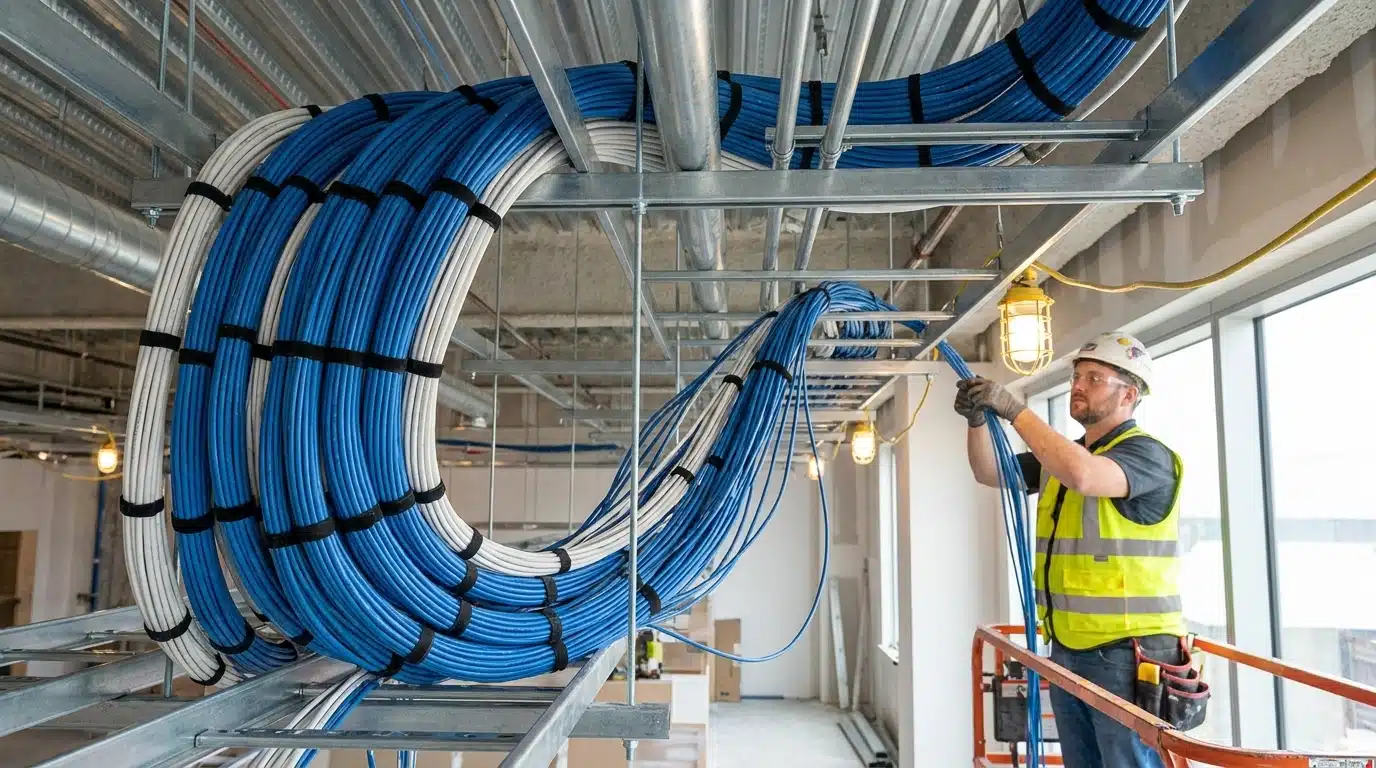
Modern open-concept ceilings and large warehouses often require specialized equipment such as scissor lifts. High rafters demand the installation of organized cable pathways, such as J-hooks or cable trays, to maintain safety. These environments increase the time required for each run and add equipment rental fees to the total project budget.
Wall Construction: Metal Studs, Wood Studs, and Concrete Masonry
The makeup of building walls significantly impacts how easily a technician can route a cable to a termination point. Standard interior drywall over metal or wood studs is the simplest scenario for most installers. They can use glow rods to drop cables through the hollow cavities, making it easy to reach the wall outlet.
Concrete block, stone, or brick masonry walls are much more difficult to navigate during a cabling project. It is often impossible to route a cable inside these walls without performing extensive core drilling. Core drilling is time-consuming and requires specialized tools, increasing the labor portion of the facility manager’s estimate.
When wall fishing is not structurally feasible, installers must use surface-mounted pathways, such as plastic or metal raceways. These solutions protect the cable and provide a path to the workstation without cutting into the masonry. While functional, surface mounting involves more visible hardware and requires careful planning to maintain a clean, professional appearance.
Floor Core Drilling and Trenching
Many modern open-plan offices and manufacturing facilities require data connections in the middle of a concrete floor slab. Pulling cable to these center-floor workstations requires core drilling or concrete trenching. Before cutting, commercial contractors must conduct Ground-Penetrating Radar scanning to prevent cutting into critical structural post-tension cables, electrical conduits, or active plumbing. GPR scanning and concrete drilling add an extra $300 to $800 per core hole on top of standard labor rates, making floor drops the most complex architectural runs.
Labor Rates and Regional Dynamics
Standard hourly technician rates for low-voltage work typically range from $50 to $150 per hour. Understanding current low-voltage wiring labor rates is essential for accurate budgeting, as these rates fluctuate based on market demand. Contractors use historical data to convert these hourly costs into fixed per-drop bids for their commercial clients.
Local regulatory factors, such as prevailing wage requirements, can also influence the total labor budget. Public or government-funded projects often mandate pay scales higher than standard market rates. These requirements must be factored into the initial estimate to ensure compliance with local labor laws and government contracts.
Market conditions and licensing requirements in specific regions, such as Florida, also play a role in pricing. Municipal fees and the cost of maintaining specialized insurance contribute to the overhead of established providers. Working with a licensed contractor ensures that the labor is performed by qualified individuals who understand local building codes and safety regulations.
Case Studies: Real-World Network Cabling Estimates
To help visualize these variables in action, consider these two common commercial installation scenarios.
Scenario A: Standard Small Office Expansion
- Scope: 10 Cat6 drops in a finished office space with acoustic drop ceilings and drywall partitions.
- Infrastructure: 1 x 24-port patch panel, faceplates, surface jacks, and standard ANSI/TIA certification.
- Total Budget Range: $1,500 to $2,000 (effectively $150 to $200 per drop, absorbing minor mobilization overhead).
Scenario B: Industrial Warehouse or Distribution Center Buildout
- Scope: 50 Cat6a drops spanning a large footprint, with runs routed along open metal joists and dropped through surface-mounted metal conduit to industrial workstations.
- Equipment: Scissor lift rental, 2 x 24-port patch panels, industrial-grade shielded jacks, and full GPR scanning for floor penetrations.
- Total Budget Range: $9,000 to $12,000 (effectively $180 to $240 per drop, driven by lift hire and rigid conduit labor).
Economies of Scale: Drop Count Brackets and Budgeting Sizes
The total volume of connections in a project directly affects unit pricing when estimating network cabling. Larger jobs allow for more efficient use of labor and materials, which can lower the average cost per drop. Understanding how these brackets work helps facility managers plan their infrastructure expansions more effectively over several years.
Installers often recommend running 20% to 30% more drops than currently needed during a major project. Pulling a spare cable during the initial installation phase is significantly cheaper than calling a crew back for a small job later. Pulling spare cables provides immediate scalability for future hires or additions of new equipment without incurring another mobilization fee.
Project Size Brackets: Small vs. Mid-Sized Installations
Small-scale installations—such as medical clinic expansions or retail store setups—often incur the highest per-drop costs. Why? Because a tiny number of connections must absorb the costs of mobilization, travel time, and administrative overhead. A crew might spend hours just setting up tools and mapping pathways before pulling a single wire, making those initial 10 to 25 drops quite expensive. Contractors frequently apply minimum service charges to keep these jobs profitable.
Conversely, mid-sized corporate buildouts of 50 to 150 drops hit the pricing sweet spot. Crews can establish organized pull trunks and route dozens of cables simultaneously, slashing the labor hours required per connection. Administrative costs stretch across a larger unit volume, and bulk material discounts kick in, bringing the per-drop average down significantly.
MDF and IDF Buildout Costs: Essential Infrastructure for Commercial Networks
Do not overlook the centralized telecommunications closet. A basic Main Distribution Frame or Intermediate Distribution Frame buildout typically adds $1,500 to $4,000 to the project budget. This covers hardware like standard 19-inch equipment racks, patch panels, horizontal and vertical wire managers, and a dedicated grounding busbar. Professional installers must tie the cabling rack into the building’s main grounding system in compliance with ANSI/TIA-607-C to prevent electrostatic discharge from damaging active switches and firewalls. A structured closet allows IT teams to execute moves, adds, and changes quickly, preventing ‘cable spaghetti’ that chokes airflow and leads to hardware overheating.
The Value of Certified Cable Testing and Performance Reports
Cheap bids often bypass the mandatory post-installation testing required for performance validation. Low-cost contractors typically use simple ‘continuity’ wire-map testers, which only check if the copper strands are connected on both ends. This does not verify the bandwidth capacity or detect near-end crosstalk and attenuation. Low-voltage installers use expensive, calibrated analyzers like the Fluke DSX-8000 to perform a comprehensive sweep test.
This verifies that each Cat6 or Cat6a channel fully complies with the physical performance limits specified in ANSI/TIA-568.2-D. Certification is your only real defense against silent network bottlenecks; industry data from the Uptime Institute indicates that IT and network infrastructure issues account for 23% of major, impactful data center outages, with average downtime costs reaching thousands of dollars per minute. Always demand a PDF printout of the Fluke certification report showing a ‘Pass’ rating for every numbered drop.
Power over Ethernet Costs and Considerations
Modern commercial networks rely on Power over Ethernet to power devices such as IP cameras, VoIP phones, and wireless access points. Using a single cable to deliver both data and power reduces the need for separate electrical outlets at every device location. Combining power and data simplifies the infrastructure but requires higher-grade cabling to manage the heat generated by the power load.
Cat6a is the preferred choice for high-power PoE++ applications because its thicker conductors dissipate heat more effectively. If a facility uses lower-grade cable for high-wattage PoE, the internal temperature of the cable bundles can rise, leading to signal degradation. Choosing the right cable category from the start ensures the safety and reliability of your PoE-driven devices.
Secure Your Infrastructure: Request a Custom Cabling Estimate
Investing in structured cabling is a long-term capital improvement. While standard office drops run $125 to $350, selecting the right cable category, designing efficient routing paths, and insisting on verified certification are what protect your business from costly performance issues. A high-quality physical layer outlasts multiple generations of active network hardware, laying a resilient foundation for your company’s operational growth.
Suncoast Power is built on over 30 years of high-quality commercial and industrial electrical contracting. We provide the technical precision required for complex low-voltage installations in Tampa and throughout Florida. Whether you are budgeting for a new warehouse buildout or a corporate office upgrade, our team ensures your infrastructure meets ANSI/TIA-568 standards. We handle the permitting, installation, and certification processes to give you peace of mind and a high-performance network.
Contact us today to schedule a professional site walkthrough for your next infrastructure upgrade.